How Safe Are Dental Implants If You Have Diabetes?

FACT CHECKED

You have diabetes and you’re missing one or more teeth. You want implants but you’ve been told, or you’ve read, that diabetes makes it risky. You want a straight answer before booking anything.
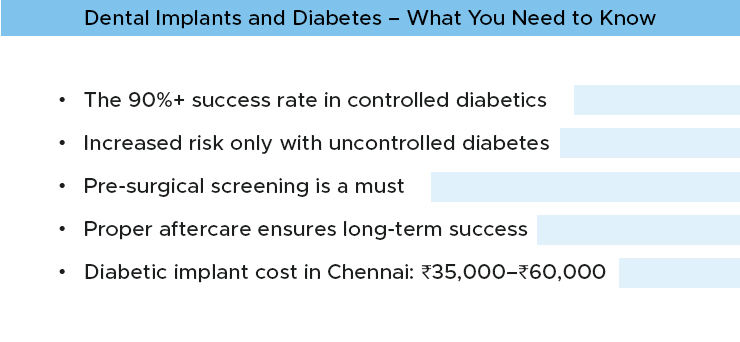
Here it is. Diabetes does not automatically disqualify you from dental implants. Blood sugar control is the deciding factor, not the diagnosis itself. According to a 2024 systematic review published in Cureus, implant survival rates in well-controlled diabetic patients with an HbA1c below 8% ranged from 96.1% to 97.3% at one year, which is comparable to non-diabetic patients.
The risks are real. They’re also manageable with the right preparation and the right clinical team. At Radiant Dental Care, one of the best dental implant clinics in Chennai for complex cases, every diabetic implant patient goes through a pre-implant diabetic assessment before any procedure is scheduled. Dr Sreekanth Kandepu, MDS, AAID, Co-Founder and Executive Director, leads implant treatment planning across all 10 Chennai locations.
Why Does Diabetes Affect Dental Implant Treatment?
Dental implants work through a process called osseointegration, where the titanium post placed in the jawbone fuses directly with the bone over several months. Diabetes affects this process through three specific mechanisms.
Impaired Bone Healing
Persistently high blood sugar, called hyperglycaemia, reduces blood flow through small vessels, impairs the function of bone-forming cells, and disrupts collagen synthesis. All three affect how well and how quickly the bone fuses with the implant. According to published research in the PMC on glycaemic control and implant stability, these impairments are directly linked to HbA1c levels.
Higher Infection Risk
High glucose levels reduce white blood cell function, weakening the immune response after surgery. This raises the risk of peri-implantitis, which is infection and inflammation around the implant, a condition that can cause implant failure if not caught and treated early.
Slower Wound Healing
Diabetic patients heal more slowly after any surgical procedure. The osseointegration period typically extends from the standard 3 to 6 months to 4 to 8 months in diabetic patients. This is expected and accounted for in treatment planning, not a reason to avoid implants.
What HbA1c Level Is Required Before Implant Surgery?
HbA1c is a blood test that measures average blood sugar control over the previous two to three months. It is the primary clinical measure used to assess implant suitability in diabetic patients.
| HbA1c Level | Clinical Position on Implants |
|---|---|
| Below 7% | Preferred threshold. Implant surgery can proceed in most cases. |
| 7% to 8% | May be acceptable depending on overall health and clinical assessment. |
| Above 8% | Surgery is generally deferred until blood sugar is better controlled. Risk of healing complications is significantly higher. |
One additional point: surgery itself temporarily raises blood sugar due to procedural stress and inflammation. Coordination with your diabetes physician before and after the procedure is essential, not optional.
Can Both Type 1 and Type 2 Diabetics Get Implants?
Yes. Both Type 1 and Type 2 diabetic patients can receive dental implants successfully when blood sugar is well-managed. The controlling factor is glycaemic stability, not the type of diabetes. The preparation, monitoring, and post-operative care are the same for both.
How to Prepare for Dental Implants If You Have Diabetes?
Preparation is where most of the safety work happens. These steps apply before any implant procedure is scheduled.
- Get your HbA1c tested and aim for a level below 7% before scheduling surgery
- Coordinate with your physician to confirm your diabetes is stable. Your dental team may request a medical clearance letter before proceeding.
- Treat any active gum disease before implant placement. Gum treatment reduces the bacterial load around the surgical site and lowers complication risk.
- Inform your dental team of all current medications, including any that affect blood pressure, kidney function, or blood clotting
- Stop smoking if you currently smoke. Smoking impairs blood supply to gum and bone tissue and is an independent risk factor for implant failure.
- Maintain regular meals around the surgery date to avoid blood sugar fluctuations on the day of the procedure
What Post-Operative Care Looks Like for Diabetic Patients?
Post-operative care for diabetic implant patients is more structured than for non-diabetic patients, with closer monitoring during the osseointegration period.
- Healing takes 4 to 8 months rather than 3 to 6 months. This is normal and planned for in your treatment timeline.
- Blood sugar monitoring during recovery is essential. Surgical stress can temporarily elevate levels even in well-controlled patients.
- Antibiotics are commonly prescribed after implant surgery to reduce infection risk during early healing. Complete the full course.
- More frequent follow-up appointments are scheduled during osseointegration to monitor for early signs of peri-implantitis.
- Contact your dental team immediately if you notice unusual swelling, persistent pain after the first week, or discharge from the implant site.
What Does Dental Implant Treatment Cost for Diabetic Patients in Chennai?
Dental implants in Chennai range from ₹25,000 to ₹60,000 per tooth depending on implant brand, crown material, and case complexity. There is no fixed additional cost for diabetic patients. If bone grafting is needed due to insufficient jaw bone, or if additional monitoring appointments are required, those are costed individually based on the clinical requirements of your case.
A confirmed cost estimate requires a clinical examination, OPG imaging, and HbA1c review. For a full breakdown of what affects implant pricing, the dental implant cost guide covers all variables in detail.
Book Your Diabetic Implant Assessment at Radiant Dental Care
If you have diabetes and want to know whether you’re a candidate for dental implants in Chennai, a proper clinical assessment gives you a clear answer based on your specific health and dental situation.
For patients looking for the best dental implant clinic in Chennai for diabetic cases, Radiant Dental Care provides the following across all 10 locations:
- Pre-implant diabetic assessment including HbA1c review and oral examination
- OPG imaging and 3D digital scan for implant planning
- Dental implant treatment including single tooth, multiple teeth, and full arch options
- All-on-4 implants for patients needing full arch replacement
- Guided implant surgery for complex cases requiring precise placement
- Bone grafting where needed before implant placement
- Class B autoclave-sterilised instruments across all 10 clinics
- Written cost estimate after full assessment, before treatment begins
- Warranty-backed implant treatment in eligible cases
Patients searching for dental implants near me across Chennai, or the best dental clinic in Chennai for diabetic oral care, will find Radiant Dental Care in Adyar, Tambaram East, Chromepet, Nanganallur, Medavakkam, Navalur OMR, Siruseri OMR, Perungudi OMR, Guduvanchery, and Thiruporur.
For patients looking for the best dentist in Chennai or the best dental hospital in Chennai for implant cases involving systemic health conditions, Radiant Dental Care coordinates with your physician team as part of the pre-implant workup. Open 365 days, 10 AM to 9 PM.
Patients searching for dental care near me can walk in or book online.
Call us now at +91 9513446186 and book your diabetic implant assessment at Radiant Dental Care.
Frequently Asked Questions
Can Diabetics Get Dental Implants Safely?
Yes, when blood sugar is well-controlled. Published clinical research shows implant survival rates comparable to non-diabetic patients when HbA1c is below 8%.
What HbA1c Level Is Needed Before Dental Implant Surgery?
Below 7% is the preferred threshold. Levels between 7% and 8% may be acceptable depending on overall health. Above 8%, surgery is generally deferred until control improves.
Does Diabetes Increase the Chance of Implant Failure?
Poorly controlled diabetes does. Well-controlled diabetes, with HbA1c within target range, significantly reduces that risk and produces outcomes comparable to non-diabetic patients.
How Long Does Osseointegration Take for Diabetic Patients?
Typically 4 to 8 months, compared to 3 to 6 months in non-diabetic patients. The longer timeline is expected and monitored with more frequent follow-up appointments.
Is Bone Grafting Always Needed for Diabetic Implant Patients?
No. Bone grafting is needed when jaw bone volume is insufficient for implant placement, regardless of diabetes. Not every diabetic patient requires it. OPG imaging confirms bone volume before planning.
How Much Do Dental Implants Cost in Chennai for Diabetic Patients?
Standard implants range from ₹25,000 to ₹60,000 per tooth. There is no fixed diabetic surcharge. Additional costs depend on whether bone grafting or extra monitoring is clinically required for your case.
Categories:
- Braces
- Cavity
- Crossbite
- Dental Bridge
- dental care
- Dental Clinic
- Dental Crown
- dental health
- dental hospital
- Dental Implants
- Franchise
- Home dentist
- invisalign
- Mamelons
- News
- pediatric dentist
- Root Canal Treatment
- Smile Makeover
- Teeth Aligners
- teeth alignment
- teeth cleaning
- teeth whitening treatment
- tooth extraction
- Tooth Hypersensitivity
- Uncategorized
Trending Posts
 +91 9513446186