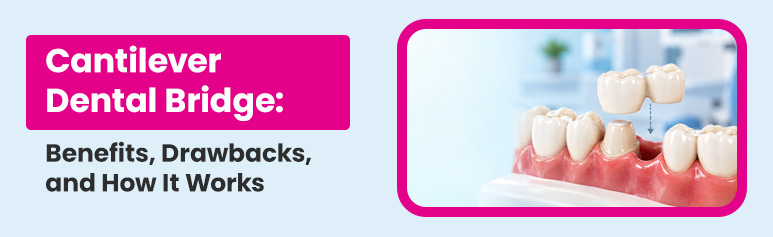
Cantilever Dental Bridge: Benefits, Drawbacks, and How It Works

FACT CHECKED
You’ve lost a tooth, and your dentist has suggested a bridge that’s supported on one side only. You’re wondering whether one tooth is strong enough to hold it.
A cantilever dental bridge is a fixed false tooth attached to a single neighbouring tooth, with nothing supporting it on the other side. It can work well for a single missing front tooth when the support tooth is healthy and strong. It’s less suited to back teeth, which take heavy chewing force.
Below, we explain the benefits, drawbacks and how it works, using what 10 years of research shows. At Radiant Dental Care, we plan crowns and bridges with digital scans and CAD/CAM design across 10 clinics in Chennai. If you’re also weighing up an implant, we’ll compare the two options as well.
How Does a Cantilever Dental Bridge Work?
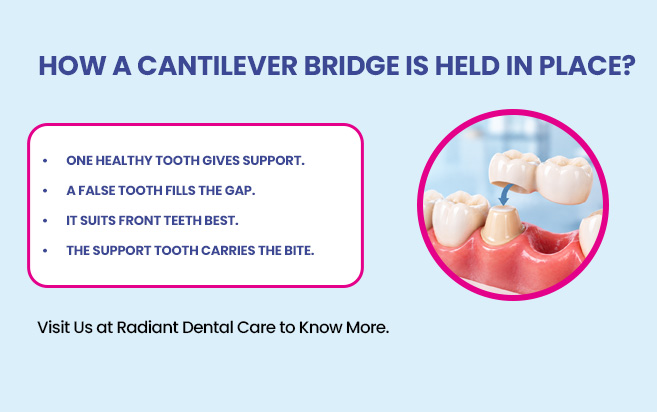
A cantilever bridge attaches a false tooth to one supporting tooth, and the false tooth extends into the gap. It works like a shelf fixed to a single wall.
Two clinical terms explain how the bridge holds:
- The abutment is the natural tooth that supports the bridge.
- The pontic is the false tooth that fills the gap.
When you bite on the pontic, the force passes to the abutment. Because there’s no tooth on the other side, that one tooth carries the whole load. This is why the support tooth and your bite matter so much.
What Are the Two Types of Cantilever Dental Bridge?
The term “cantilever bridge” covers two quite different treatments:
- In a conventional cantilever bridge, we shape the support tooth and cover it with a crown, and the pontic is joined to that crown.
- In a resin-bonded cantilever bridge, a thin wing bonds to the back of the support tooth with little or no drilling, and the pontic is attached to that wing.
Who Is a Good Candidate for a Cantilever Bridge?
A good candidate is usually missing one tooth, often at the front, and has one strong, healthy tooth beside the gap.
A cantilever bridge may suit you in these situations:
- You’re missing a single front tooth.
- The neighbouring tooth has a strong, healthy root.
- The gums and bone around that tooth are healthy.
- Your bite is normal, and you don’t grind your teeth heavily.
A cantilever bridge may not suit you in these situations:
- The missing tooth is a back tooth that takes heavy chewing force.
- You often grind or clench your teeth.
- The support tooth is weak, cracked or heavily filled.
- You have active gum disease.
What Are the Pros and Cons of Cantilever Bridges?
The main benefit is that only one neighbouring tooth is involved. The main drawback is that the same tooth carries all the load. Each benefit comes with a matching drawback, and here’s the complete list of pros and cons of cantilever bridges.
| Benefit | Drawback |
|---|---|
| Only one neighbouring tooth is involved. | That one tooth carries the full bite load. |
| The bridge is fixed and doesn’t come out. | You need to clean carefully under the false tooth. |
| It looks natural for front teeth. | It isn’t suited to heavy chewing at the back. |
| Treatment is shorter than an implant. | The bridge may need recementing or repair later. |
| No surgery is needed. | A crowned support tooth can lose its nerve over time. |
Will a Cantilever Bridge Damage the Supporting Tooth?
It can, which is why the choice of support tooth and design matters so much.
A 2004 systematic review in Clinical Oral Implants Research tracked conventional cantilever bridges over 10 years. It estimated that 81.8% were still in place at 10 years. A companion review found 89.1% for conventional bridges supported on both sides.
The same cantilever review reported these common problems:
- The support tooth’s nerve died in 32.6% of cases, which dentists call loss of tooth vitality.
- Decay developed at the support tooth in 9.1% of cases.
- The bridge came loose in 16.1% of cases.
- The bridge material fractured in 5.9% of cases.
A 2017 systematic review in the same journal found resin-bonded bridges had an estimated 10-year survival of 82.9%. Those with a single support tooth showed the highest survival. A 2024 review of all-ceramic resin-bonded bridges found that designs with one support tooth had an advantage over two.
How Can You Lower the Risk of a Cantilever Bridge Failing?
These steps help protect the support tooth:
- Choose a support tooth with a strong root and healthy gums.
- Let your dentist pick the design based on your bite, not on cost alone.
- Wear a night guard if you grind your teeth.
- Clean under the false tooth every day.
- Attend regular check-ups so problems are caught early.
What Happens During Cantilever Bridge Treatment?
Most patients need two visits, a few weeks apart. According to Cleveland Clinic, a dental lab usually takes two to four weeks to make a bridge.
Here’s the usual sequence:
- We examine the area and take an X-ray of the support tooth.
- We shape the support tooth for a crown, or prepare its back surface for a bonded wing.
- We take a digital scan of your teeth.
- You wear a temporary tooth while the bridge is made.
- We fit the final bridge, check your bite and fix it in place.
Should You Choose a Cantilever Bridge or Dental Implants in Chennai?
The right choice depends on your jawbone, your neighbouring teeth and whether you’d rather avoid surgery.
| Factor | How the two options compare |
|---|---|
| Surgery | A bridge needs no surgery, while an implant needs minor surgery to place a post in the jawbone. |
| Neighbouring teeth | A bridge relies on one neighbouring tooth, while an implant leaves the neighbours untouched. |
| Treatment time | A bridge takes a few weeks, while an implant usually takes a few months to heal. |
| Bone needs | A bridge doesn’t need bone at the gap, while an implant needs enough jawbone. |
If you’re weighing up dental implants in Chennai, we’ll check your bone, gums and bite before recommending either. Some patients choose partial dentures instead, which you can remove.
How Long Does a Cantilever Bridge Last, and How Do You Care for It?
A cantilever bridge has no fixed lifespan. It depends on the support tooth, the design, your bite and your daily cleaning.
Daily care makes the biggest difference:
- Clean under the false tooth with a floss threader or a water flosser.
- Brush carefully around the support tooth, especially at the gumline.
- Avoid biting hard objects, like ice or nut shells, with the bridge.
- Visit your dentist for a check-up every six months.
How Do You Choose a Dental Clinic in Chennai for a Cantilever Bridge?
Choose a clinic that checks your support tooth first and explains every option before recommending a cantilever. Whether you’re comparing the best dentist in Chennai or a dental hospital in Chennai, ask why a cantilever suits your tooth. A good dental clinic in Chennai should also show you the alternatives.
How Does Radiant Dental Care Plan Cantilever Bridges?
We only recommend a cantilever design when your support tooth, gums and bite suit it. Our planning covers four steps:
- We take a digital scan and use computerised crown and bridge design for an accurate fit.
- We check your bite to see how much force the support tooth will take.
- We explain whether a conventional or resin-bonded design suits you.
- We explain how our bridge warranty applies to your case.
Is a Cantilever Dental Bridge the Right Choice for Your Missing Tooth?
A cantilever bridge can restore a missing front tooth without surgery, using just one neighbouring tooth. That same tooth carries the risk, so its strength decides whether the bridge is a good choice. A careful check of your support tooth and bite tells you which option makes sense.
Book a Cantilever Bridge Consultation at Radiant Dental Care
Book a consultation at the Radiant Dental Care clinic nearest you. We’ll check your support tooth and our affordable and best dentist near me will explain whether a cantilever bridge, a traditional bridge or an implant suits you.
- Call us on +91 95134 46186.
- Message us on WhatsApp at +91 91761 66789.
- We’re open 365 days a year, from 10 AM to 9 PM.
- Our clinics are in Adyar, Chromepet, Guduvanchery, Medavakkam, Nanganallur, Tambaram East and Thiruporur, plus Navalur, Perungudi and Siruseri on OMR.
You can find your nearest clinic for directions and branch details.
Frequently Asked Questions About Cantilever Bridges
Can a cantilever bridge replace a back tooth?
Usually, it can’t. Back teeth take heavy chewing force, which can overload a single support tooth. In selected cases, a dentist may consider one for a premolar.
Does getting a cantilever bridge hurt?
You’ll get local anaesthesia while the support tooth is prepared, so you shouldn’t feel pain. Mild sensitivity for a few days afterwards is common.
Can a root canal treated tooth support a cantilever bridge?
Sometimes it can, but it needs careful assessment. Root canal treated teeth can be more brittle, so we check the remaining tooth structure first.
What happens if a cantilever bridge comes loose?
Keep the bridge safe and contact us. If the support tooth is healthy, a loose bridge can often be cleaned and cemented back in place.
Is a cantilever bridge cheaper than a dental implant?
A cantilever bridge often costs less at the start, because it needs no surgery. The total cost depends on the materials, the design and any work needed on the support tooth.
Categories:
- Braces
- Cavity
- Crossbite
- Dental Bridge
- dental care
- Dental Clinic
- Dental Crown
- dental health
- dental hospital
- Dental Implants
- Franchise
- Home dentist
- invisalign
- Mamelons
- News
- pediatric dentist
- Root Canal Treatment
- Smile Makeover
- Teeth Aligners
- teeth alignment
- teeth cleaning
- teeth whitening treatment
- tooth extraction
- Tooth Hypersensitivity
- Uncategorized
Trending Posts
 +91 9513446186