What Is a Cone Beam CT Scan (CBCT) and How Does It Work?

FACT CHECKED
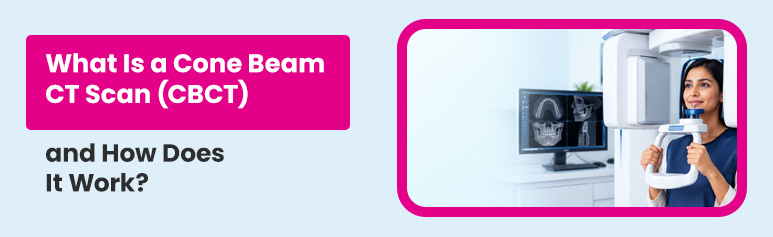
Your dentist has asked for a CBCT scan, and you’re not sure why a normal X-ray isn’t enough. You may also be worried about the radiation. So, what is a cone beam CT scan (CBCT), and how does it work?
A cone beam CT scan is a dental X-ray scan that builds a 3D image of your teeth, jawbone and nerves. A cone-shaped beam circles your head once, and software turns the images into a 3D model. Dentists use it only when flat X-rays can’t answer a clinical question. It gives more radiation than a dental X-ray but far less than a medical CT scan.
At Radiant Dental Care, we use CBCT images to plan implants, wisdom tooth removal and complex treatment. Here’s all about Cone Beam CT Scan (CBCT) and how does it work, when you need one and how safe it is.
How Does a Cone Beam CT Scan Work?
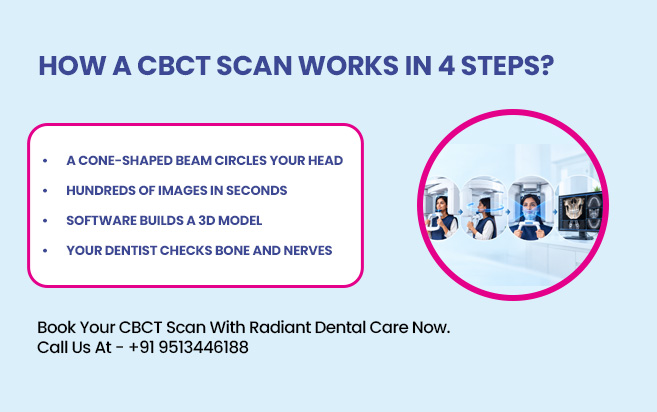
A cone-shaped X-ray beam rotates around your head once, and a computer turns hundreds of images into one 3D model. Your dentist can then view your jaw from any angle, slice by slice.
Here’s what happens inside the machine:
- An X-ray source and a detector sit on opposite sides of your head.
- They rotate around you together in a single circle.
- The detector captures hundreds of images from different angles.
- Software combines them into a 3D volume of your teeth and jaw.
- Your dentist studies thin slices of that volume on a screen.
The field of view (FOV) is the size of the area the scan covers. A small FOV might show two or three teeth. A large one can cover both jaws. That choice matters, because a smaller field of view usually means a lower radiation dose.
How Is CBCT Different From a Dental X-ray or OPG?
- Dental X-rays and OPGs produce flat, 2D images. CBCT adds depth, so your dentist can measure bone and see exactly where nerves and sinuses sit.
- An intraoral X-ray is a small image taken with a sensor inside your mouth, showing one to three teeth. An OPG is a single panoramic X-ray of both jaws.
| Scan | What It Shows |
|---|---|
| Intraoral X-ray | A close 2D view of a few teeth and their roots |
| OPG | A 2D overview of all teeth and both jaws |
| CBCT | A 3D view of bone, roots, nerves and sinuses |
| Medical CT | A 3D view of bone and soft tissue across a wider area |
CBCT isn’t designed to assess soft tissue problems. The US National Library of Medicine overview of dental CBCT recommends medical CT or MRI for soft tissue disease instead.
When Do Dentists Recommend a CBCT Scan?
A dentist should recommend a CBCT scan only when a 3D view could change your treatment plan. The same overview states the scan shouldn’t be taken unless its results would change that plan.
Common reasons include:
- Dental implant planning, to measure bone height and width before placing an implant
- Wisdom teeth close to the jaw nerve, to plan removal safely
- Complex root canals, extra canals or suspected root cracks
- Impacted teeth, such as canines that can’t come through on their own
- Cysts or growths inside the jaw
- Injuries to the face or jaw
An impacted tooth is one that’s blocked from coming through the gum. The inferior alveolar nerve runs inside the lower jaw and gives feeling to your lower lip and chin. CBCT shows how close a tooth or implant site sits to it.
You usually don’t need a CBCT scan for:
- Routine check-ups
- Simple cavities
- Scaling and cleaning
Is a CBCT Scan Safe?
Yes, when the scan is justified and uses the smallest field of view that answers the clinical question. Like every X-ray, it carries a small radiation risk. That’s why the reason for the scan matters as much as the scan itself.
How Much Radiation Does a CBCT Scan Give?
A microsievert (µSv) is a unit that measures radiation dose to the body. A 2015 meta-analysis in Dentomaxillofacial Radiology looked at average adult doses. It reported 84 µSv for small scans, 177 µSv for medium scans and 212 µSv for large scans. The same study found wide differences between machines, so these are averages, not fixed numbers.
Earlier research by the same lead author placed CBCT between the two scans patients usually compare it with. Its dose is several times higher than a panoramic X-ray. It’s also an order of magnitude or more lower than a conventional medical CT.
For context, a review of dental imaging studies published from 2010 to 2020 put things in proportion. It found the largest child CBCT dose was about 13% of what a person receives each year from natural background radiation.
Who Needs Extra Caution?
Some patients need a closer look at whether a scan is worth it:
- Children: The same review found child models received about 29% more dose than adults from the same scan.
- Pregnant women: Tell your dentist first. Non-urgent scans are usually postponed.
- Patients with recent scans: Share any earlier CBCT so it isn’t repeated without need.
The US FDA advises dental professionals to discuss why a scan is needed, and its benefits and risks, before taking it. If no one has explained that to you, ask.
What Happens During a CBCT Scan?
You’ll spend a few minutes in the room, but the scan itself takes only seconds. There’s no fasting, no injection and no closed tunnel.
Here’s what to expect:
- You remove earrings, glasses, hairpins and removable dentures.
- You sit or stand with your chin on a rest.
- You bite gently on a guide and stay completely still.
- The machine rotates around your head once.
- The software builds the 3D image within minutes.
- Your dentist explains what the scan shows.
Staying still matters. Even small movements can blur the image and may mean a repeat scan.
How Do You Choose a Dental Clinic in Chennai for a CBCT Scan?
Check three things: that the equipment is licensed, that the reason is explained, and that a trained dentist reads the scan. Whether you’re comparing the best dental hospital in Chennai or a dentist in Chennai you already trust, ask these questions first:
- Is the CBCT machine licensed by AERB? The Atomic Energy Regulatory Board is India’s radiation safety regulator. Every dental CBCT unit needs its licence.
- Has your dentist explained why you need the scan?
- Will they use the smallest field of view that answers the question?
- Who reads the scan and writes the report?
- Will you get a copy of your scan files?
A good dental clinic in Chennai will answer each of these clearly before your scan.
How Does Radiant Use CBCT in Treatment Planning?
We recommend a CBCT scan only when the 3D view will change your treatment. When your case needs one, we arrange the scan and plan your treatment from the images.
We use CBCT images mainly for:
- Implant planning and guided implant surgery, where the implant position is planned on screen first
- Wisdom tooth removal near the jaw nerve
- Flap surgery evaluation, to check bone levels around teeth with advanced gum disease
So, Should You Go Ahead With a CBCT Scan?
A CBCT scan gives your dentist a 3D view when flat X-rays can’t show enough. The dose depends on the size of the scan and the machine used. If your dentist can clearly explain how the scan will change your treatment, it’s usually worth taking. If they can’t, ask before you agree.
Have Questions About Your CBCT Scan?
If you’ve been searching for a dental clinic near me, one of our 10 Radiant Dental Care clinics is likely close by.Book a consultation and we’ll explain whether you need a scan at all.
- Call us: +91 95134 46186
- WhatsApp: +91 91761 66789
- Open: 365 days a year, 10 AM to 9 PM
- Clinics: Adyar, Chromepet, Guduvanchery, Medavakkam, Nanganallur, Tambaram East and Thiruporur, plus Navalur, Perungudi and Siruseri on OMR
Find your nearest clinic for directions and branch details.
Frequently Asked Questions
How long does a CBCT scan take?
The rotation itself usually takes well under a minute. Including positioning and image processing, the whole process takes only a few minutes.
Can you have a CBCT scan during pregnancy?
Tell your dentist if you’re pregnant or might be. They’ll usually delay a non-urgent scan and only go ahead if the benefit clearly outweighs the risk.
Is a CBCT scan safe for children?
It can be, when it’s truly needed. Children are more sensitive to radiation, so dentists should use the smallest field of view and the lowest dose settings that answer the question.
Does a CBCT scan hurt or feel claustrophobic?
No, it doesn’t hurt. Unlike a medical CT or MRI, you don’t lie inside a tunnel. The machine simply rotates around your head while you sit or stand.
Can you get a copy of your CBCT scan?
Yes, you can usually ask for one. The files come in a standard 3D format that another dentist can open, which helps avoid repeat scans.
Categories:
- Braces
- Cavity
- Crossbite
- Dental Bridge
- dental care
- Dental Clinic
- Dental Crown
- dental health
- dental hospital
- Dental Implants
- Franchise
- Home dentist
- invisalign
- Mamelons
- News
- pediatric dentist
- Root Canal Treatment
- Smile Makeover
- Teeth Aligners
- teeth alignment
- teeth cleaning
- teeth whitening treatment
- tooth extraction
- Tooth Hypersensitivity
- Uncategorized
Trending Posts
 +91 9513446186