Is Invisalign Really Invisible? What You Should Expect!

FACT CHECKED
Medically reviewed by Dr Soumya V, MDS (Orthodontics), Radiant Dental Care | Last updated: October 2026
You want straighter teeth, but you don’t want every client meeting or family photo to show it. You may also wonder whether wearing plastic trays all day is safe. So, is Invisalign really invisible?
Not completely. Invisalign is a branded clear aligner system that moves teeth with custom, removable plastic trays. It’s nearly invisible at normal speaking distance, but small details can show up close, in bright light or on camera.
On safety, research supports clear aligners for teeth and gums when a dentist plans and monitors treatment. Studies on the plastic itself are still ongoing.
At Radiant Dental Care, our orthodontists plan aligner treatment across 10 dental clinics in Chennai. Below, we explain what people can actually see and what the research says about Invisalign safety. We also cover what the first weeks with Invisalign feel like.
How Invisible Is Invisalign in Everyday Life?
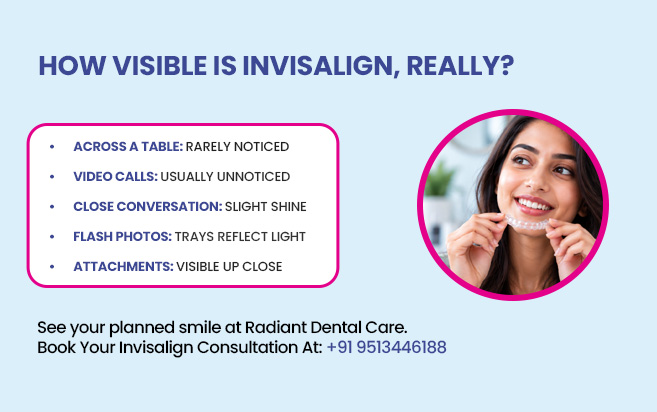
Most people won’t notice your aligners during a normal conversation. The trays are thin, clear and shaped to your teeth. What gives them away is distance, light and how closely someone looks.
| Situation | How Noticeable It Is |
|---|---|
| Talking across a desk or table | Rarely noticed |
| Office meetings and video calls | Usually unnoticed, unless the camera is close |
| Close conversation | A slight shine on the teeth may show |
| Bright sunlight or camera flash | Trays can reflect light |
| Close-up photos | Attachments and tray edges may be visible |
Aligners are far less visible than metal or ceramic brackets. Invisalign is one of severalclear aligner systems, and all of them share these limits.
What Makes Invisalign More Noticeable?
Three things make aligners easier to spot: attachments, elastics and cloudy trays. Your treatment plan decides the first two. Your daily care decides the third.
Attachments, Buttons and Elastics
Attachments are small bumps of tooth coloured filling material bonded to some teeth. They help the trays grip and move your teeth. We choose a shade close to your teeth, so they blend in at a distance. Up close, they can make teeth look slightly ridged.
Some bite corrections also need buttons and elastics. Buttons are tiny hooks bonded to teeth, and elastics are small rubber bands stretched between them. These show more than the trays do. We tell you at the planning stage if your case needs them, and for how long.
How Do You Keep Your Aligners Clear?
Cloudy or yellowed trays stand out more than clean ones. These habits keep them clear:
- Rinse the trays in cool water every time you take them out
- Brush them gently with a soft brush and mild, clear soap
- Skip toothpaste on the trays, as it can scratch and dull them
- Avoid hot water, which can warp the plastic
- Switch to each new set on schedule, since older trays dull with wear
Are Invisible Aligners Safe for Your Teeth and Health?
Yes, clear aligners are generally considered safe when a dentist plans and monitors treatment. Research on the plastic is still ongoing, so we’ll share what’s reassuring and what isn’t settled yet. Are invisible aligners safe? Everything you need to know comes down to three questions: the material, your roots and gums, and the risks that remain.
What Are Invisalign Aligners Made Of, and Is BPA a Concern?
Invisalign trays are made from SmartTrack, a multilayer plastic developed by Align Technology, the company behind Invisalign. BPA (bisphenol A) is a chemical found in some plastics that can affect hormones at high exposure.
Here’s the honest picture. A 2025 umbrella review looked at lab studies on aligner plastics. It reported that SmartTrack released more BPA and BPS than the other materials tested. The same review called for research under real mouth conditions, because lab tests don’t match daily wear. A 2025 systematic review from Universidade Católica Portuguesa found clear aligners generally safe, while noting some chemical leaching and mild gum inflammation.
So lab results show release, but researchers haven’t yet measured what it means for people wearing trays every day. If this worries you, ask us at your consultation.
Do Aligners Affect Tooth Roots and Gums?
Root resorption is the gradual shortening of tooth roots. It’s a known side effect of moving teeth with any brace or aligner. Researchers at Saveetha Dental College in Chennai co-authored a 2024 meta-analysis on this. It found less root resorption in the front teeth with clear aligners than with fixed braces. A 2026 meta-analysis in Dental and Medical Problems reached the same finding.
Periodontal health means the health of your gums and the bone holding your teeth. A 2023 umbrella review found gum health with aligners and fixed braces to be comparable. Aligners make brushing easier, but your gums still depend on how well you clean every day.
What Risks Still Exist?
Aligners lower some risks, but they don’t remove them. Watch for these:
- Cavities, if sugary drinks or food get trapped under the trays
- Plaque build up, since trays reduce saliva flow over the teeth
- Gum irritation from a rough or sharp tray edge
- Mild gum inflammation, which reviews have reported in some patients
In the first few days, tray edges can also rub your tongue or cheeks. We can smooth a rough edge in a few minutes at the clinic. Most of these issues are easy to fix when caught early. Regular reviews let us spot them before they turn into problems.
Why Should a Dentist Check Your Teeth Before Aligners Start?
Moving teeth over hidden decay or gum disease can make both worse. That’s why a full check comes before any aligner plan. An OPG is a single panoramic X-ray that shows all your teeth, roots and jawbone in one image.
A proper check before treatment looks for:
- Cavities that need filling first
- Gum disease or bone loss around teeth
- Short or unusually shaped roots
- Old fillings, crowns or root canal treated teeth
- Impacted wisdom teeth
If we find any of these, we treat them first. Your aligner plan then starts on healthy teeth and gums.
What Should You Expect During Invisalign Treatment in Chennai?
YourInvisalign treatment in Chennai starts with a fitting visit, then a short adjustment phase and regular reviews. Here’s how the first weeks usually go:
- We bond attachments to selected teeth.
- We may do IPR, which means polishing tiny amounts of enamel between teeth to create space.
- We fit your first trays and check that the edges sit comfortably.
- We show you how to insert, remove and clean them.
- You return for reviews every few weeks so we can track progress.
At your first review, we check that the attachments are holding well and the trays fit snugly.
In the first week, you’ll notice the trays far more than anyone around you does. Most people stop thinking about them once the routine settles.
Invisalign treatment cost in Chennai depends on how complex your case is. Some patients find braces suit their bite and budget better, so our orthodontists explain all your orthodontic treatment options at the consultation.
How Do We Keep Aligner Treatment Safe at Radiant?
Safe aligner treatment depends on careful planning, clean clinical work and regular follow-up. Our patient safety protocols include:
- A full dental check and orthodontist planning before aligners start
- Instruments sterilised in sealed pouches inside autoclaves
- Dental chairs with anti-retraction valves that stop fluids flowing back into the tubing
- Air purifiers and UV sterilisation in treatment areas
So, Is Invisalign Right for Discreet Treatment?
Invisalign won’t make your treatment fully invisible, but it keeps it invisible in daily life. Research supports its use for teeth and gums, while studies on the plastic continue. The right choice depends on your bite, your gum health and how visible your case needs to be. A proper assessment answers all three.
Ready to See How Invisible Your Teeth Straightening Treatment Could Be?
If you’ve been searching for dental care near me, one of our 10 Radiant Dental Care clinics is likely close by.Book an Invisalign consultation to see your planned result before you commit.
- Call us: +91 95134 46186
- WhatsApp: +91 91761 66789
- Open: 365 days a year, 10 AM to 9 PM
- Clinics: Adyar, Chromepet, Guduvanchery, Medavakkam, Nanganallur, Tambaram East and Thiruporur, plus Navalur, Perungudi and Siruseri on OMR
Find your nearest clinic for directions and branch details.
Frequently Asked Questions
Can you wear Invisalign for wedding photos?
Yes, but plan ahead. Flash and close-up shots can catch tray shine and attachments. Many patients take the trays out briefly for key photos, then put them straight back in.
Do Invisalign aligners turn yellow?
They can if you drink coloured drinks with them in or skip cleaning. You switch to a new set every one to two weeks, so stains rarely build up for long.
Are Invisalign aligners BPA-free?
Lab studies have detected BPA and BPS release from Invisalign’s SmartTrack material. Researchers haven’t yet confirmed what this means during real daily wear. Ask your orthodontist if this concerns you.
Can you get Invisalign if you have crowns or veneers?
Often, yes. Attachments may bond differently to crowns and veneers, so we check each restored tooth during planning.
Can you wear Invisalign if you have gum disease?
Not while it’s active. We treat the gum infection first and start aligners once your gums are stable.
Do attachments damage your teeth?
They’re designed to come off cleanly. At the end of treatment, we polish them away and smooth the tooth surface.
Categories:
- Braces
- Cavity
- Crossbite
- Dental Bridge
- dental care
- Dental Clinic
- Dental Crown
- dental health
- dental hospital
- Dental Implants
- Franchise
- Home dentist
- invisalign
- Mamelons
- News
- pediatric dentist
- Root Canal Treatment
- Smile Makeover
- Teeth Aligners
- teeth alignment
- teeth cleaning
- teeth whitening treatment
- tooth extraction
- Tooth Hypersensitivity
- Uncategorized
Trending Posts
 +91 9513446186