Maryland Bridges vs Dental Implants: A More Conservative Way to Replace a Missing Tooth

FACT CHECKED
You’re missing a front tooth, and you’re torn between implant surgery and a bridge that’s bonded in place.
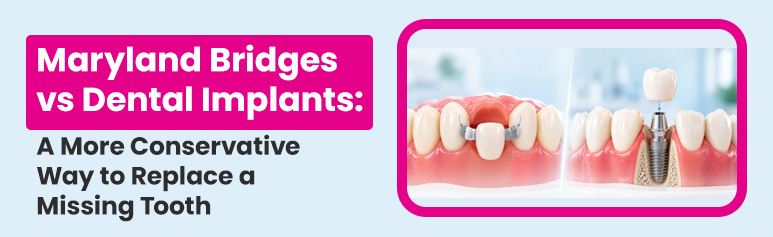
A Maryland bridge is a false tooth held by thin wings bonded to the backs of the neighbouring teeth. A dental implant is a small post placed in the jawbone that holds a crown. A Maryland bridge is the more conservative option for your natural teeth and needs no surgery. An implant leaves the neighbouring teeth untouched and has stronger long-term evidence behind it. The better choice depends on your age, your bite, your jawbone and your budget.
At Radiant Dental Care, we plan tooth replacement across 10 clinics in Chennai, and we explain both options before recommending one. Below, we compare Maryland bridge vs. dental implant: which is better, how each works, how long each lasts, what each costs over time and who each suits.
What Is a Maryland Bridge, and How Does It Differ From a Dental Implant?
A Maryland bridge sits on your natural teeth, while a dental implant sits in your jawbone. A Maryland bridge has these parts:
- The pontic is the false tooth that fills the gap.
- The wings are thin metal or ceramic plates attached to the pontic.
- The wings bond to the backs of one or two neighbouring teeth.
A dental implant has these parts:
- The implant is a small titanium or zirconia post placed in the jawbone.
- The abutment is a connector that joins the post to the crown.
- The crown is the visible tooth that sits on top.
Osseointegration is the process in which the jawbone fuses with the implant post over several months. It’s what makes an implant stable enough to chew on.
Why Is a Maryland Bridge Called a Conservative Way to Replace a Tooth?
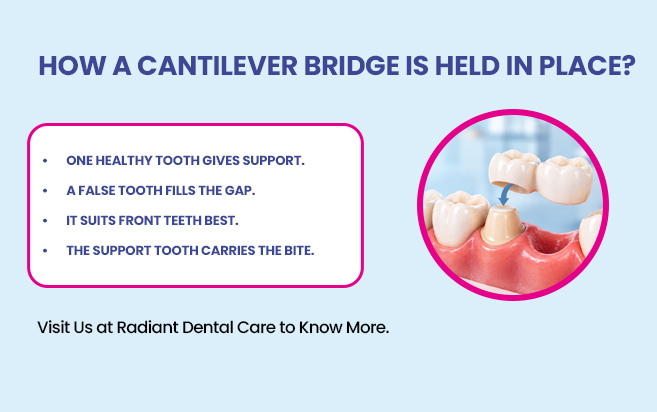
That said, an implant is conservative in a different way. It doesn’t touch the neighbouring teeth at all.
Maryland Bridge vs Dental Implant: Which Is Better for You?
Neither option is better for everyone. The right choice depends on your age, your bite, your jawbone and the health of the teeth beside the gap.
| Factor | How the two options compare |
|---|---|
| Tooth preparation | A Maryland bridge needs little or no enamel removed, while an implant needs none from the neighbouring teeth. |
| Surgery | A Maryland bridge needs no surgery, while an implant needs a minor procedure to place the post. |
| Treatment time | A Maryland bridge takes a few weeks, while an implant usually takes a few months. |
| Jawbone | A Maryland bridge doesn’t depend on bone at the gap, while an implant needs enough healthy bone. |
| Growing jaws | A Maryland bridge can be used while the jaw is still growing, while an implant usually can’t. |
| Chewing strength | A Maryland bridge suits lighter front-tooth biting, while an implant handles heavier chewing. |
| Main problem | A Maryland bridge can come loose at the bond, while an implant crown may need replacing over time. |
Will a Maryland Bridge Fall Off, and How Long Do Dental Implants Last?
A Maryland bridge can come loose, usually where the wing bonds to the tooth. Single implants show higher survival over 10 years in long-term studies.
Here’s what the research shows:
- A 2017 systematic review in Clinical Oral Implants Research estimated that 91.4% of resin-bonded bridges survived 5 years, and 82.9% survived 10 years.
- A 2012 systematic review in the same journal reported that 95.2% of single implants survived 10 years.
- A 2016 review in the European Journal of Oral Implantology found that 89.5% of the original implant crowns were still in place at 10 years.
That last figure matters. The implant post usually lasts, but the crown on top may need replacing as part of normal maintenance.
What Happens If a Maryland Bridge Comes Loose?
A loose Maryland bridge usually comes off in one piece, so it can often be fixed back in place. If yours comes loose, take these steps:
- Keep the bridge safe in a clean container.
- Don’t try to glue it back yourself.
- Call us to book a visit as soon as you can.
- Let us check the support teeth for decay before rebonding.
Who Should Choose a Maryland Bridge, and Who Should Choose a Dental Implant?
A Maryland bridge often suits young patients and front teeth. An implant often suits adults with enough jawbone who want the most durable option.
A Maryland bridge may suit you in these situations:
- You’re a teenager or young adult whose jaw is still growing.
- You’re missing a front tooth that takes light biting force.
- The neighbouring teeth are healthy and have enough enamel for bonding.
- You’d prefer to avoid surgery, or a medical condition rules it out.
A dental implant may suit you in these situations:
- You’re an adult whose jaw has finished growing.
- You have enough healthy jawbone at the gap, or you’re open to bone grafting.
- You’re replacing a back tooth that takes heavy chewing force.
- You want the option with the strongest long-term evidence.
Neither option may suit you until other problems are treated. These include active gum disease, untreated decay and heavy grinding without a night guard.
How Do the Costs of a Maryland Bridge and a Dental Implant Compare Over Time?
A Maryland bridge usually costs less upfront. An implant costs more at the start, but it may need fewer replacements over many years.
If you’re searching for affordable dental implants, ask exactly what each quote includes.
These factors change the total cost of each option:
- The implant system and crown material used.
- Any bone grafting needed before the implant is placed.
- The wing material used for a Maryland bridge.
- Any rebonding visits if a Maryland bridge comes loose.
- The cost of replacing the bridge or the implant crown in the future.
What Happens During Maryland Bridge and Dental Implant Treatment?
A Maryland bridge usually takes two visits a few weeks apart. An implant takes several visits over a few months.
Maryland bridge treatment follows these steps:
- We examine the gap and check the neighbouring teeth.
- We lightly prepare the backs of the support teeth, if needed.
- We take a digital scan, and a lab makes the bridge.
- We bond the bridge in place and check your bite.
Dental implant treatment follows these steps:
- We examine your mouth and take X-rays or a 3D scan of the jawbone.
- We place the implant post under local anaesthesia.
- You wait a few months while the bone fuses with the post.
- We fit the abutment and the final crown.
How Does Radiant Dental Care Help You Choose the Right Tooth Replacement?
We explain both options and recommend one only after checking your teeth, bite and jawbone. As a dental clinic in Chennai with 10 branches, we offer these services under one roof:
- We plan dental implants with guided implant surgery, where the implant position is planned on screen first.
- We design bridges and crowns with computerised CAD/CAM technology for an accurate fit.
- We explain how our treatment warranty applies to the option you choose.
Is a Maryland Bridge or a Dental Implant the Right Choice for Your Missing Tooth?
A Maryland bridge protects your natural teeth and avoids surgery, which makes it a strong choice for young patients and front teeth. An implant leaves the neighbouring teeth untouched and has stronger 10-year evidence. Your age, bone and bite decide which one fits. A full assessment gives you a clear answer.
How Can You Book a Tooth Replacement Consultation at Radiant Dental Care?
If you’ve been searching for a dentist near me, one of our 10 Radiant Dental Care clinics is likely close by.Book a consultation, and we’ll explain whether a Maryland bridge or an implant suits you.
- Call us on +91 95134 46186.
- Message us on WhatsApp at +91 91761 66789.
- We’re open 365 days a year, from 10 AM to 9 PM.
- Our clinics are in Adyar, Chromepet, Guduvanchery, Medavakkam, Nanganallur, Tambaram East and Thiruporur, plus Navalur, Perungudi and Siruseri on OMR.
You can find your nearest clinic for directions and branch details.
Frequently Asked Questions
Can a Maryland bridge replace a back tooth?
A Maryland bridge usually isn’t used for back molars. Heavy chewing force can break the bond, so it’s mainly used for front teeth and sometimes premolars.
Can you switch from a Maryland bridge to a dental implant later?
Yes, you usually can. We remove the bridge, check your jawbone and plan the implant. Some patients need a bone graft first if the bone has shrunk.
Does a Maryland bridge damage the neighbouring teeth?
A Maryland bridge removes little or no enamel, so the damage is minimal. Decay can develop if a wing loosens unnoticed, which is why regular check-ups matter.
At what age can you get a dental implant?
Most people can get an implant once their jaw has stopped growing. That’s often in the late teens or early twenties, but we confirm it with X-rays.
Does dental implant surgery hurt?
You’ll get local anaesthesia, so you shouldn’t feel pain during the procedure. Mild soreness and swelling for a few days afterwards is common.
Categories:
- Braces
- Cavity
- Crossbite
- Dental Bridge
- dental care
- Dental Clinic
- Dental Crown
- dental health
- dental hospital
- Dental Implants
- Franchise
- Home dentist
- invisalign
- Mamelons
- News
- pediatric dentist
- Root Canal Treatment
- Smile Makeover
- Teeth Aligners
- teeth alignment
- teeth cleaning
- teeth whitening treatment
- tooth extraction
- Tooth Hypersensitivity
- Uncategorized
Trending Posts
 +91 9513446186