What is the Role of RVG & OPG X-Rays in Dental Diagnosis?

FACT CHECKED
Your dentist examines your tooth, then says, “Let’s take an X-ray.” Fair question: why? What’s it actually going to show that a mirror and a poke can’t?
The honest answer is that a lot of dental problems start below what the eye can see. Decay between teeth, infection near a root, a wisdom tooth still growing sideways under the gum. RVG and OPG X-rays are the two tools dentists reach for, to catch these early, before they turn into something painful.
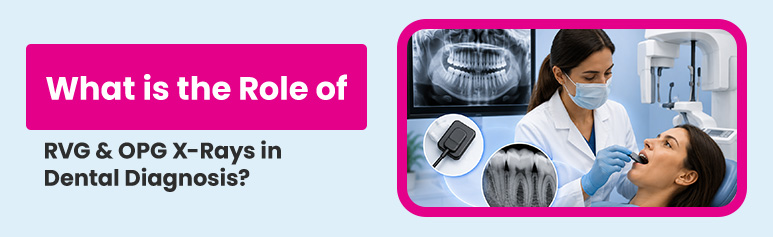
RVG, or RadioVisioGraphy, gives an instant, high-resolution close-up of one to four teeth at a time. OPG, or orthopantomogram, takes a single wide panoramic image covering your entire upper and lower jaw, and the bone structures around them.
This guide, reviewed by Dr. Sreekanth Kandepu, MDS, AAID, at Radiant Dental Care, covers when RVG and OPG X-rays are actually needed, how they differ, and how Radiant Dental Care uses them across its Chennai clinics.
When is an RVG X-Ray Needed, and What’s Its Role?
An RVG X-ray, short for RadioVisioGraphy, is a digital X-ray taken with a small sensor placed inside your mouth. It captures a close, detailed image of one tooth or a small group of teeth, and the image shows up on screen within seconds.
Its role is precision. A dentist from the best dental clinic in Chennai reaches for an RVG to look closely at one specific spot, while the rest of the mouth stays out of frame entirely.
- Spotting a cavity between two teeth, before it’s visible or painful
- Checking how a root canal treatment is progressing, layer by layer
- Confirming a filling or crown fits properly against the tooth
- Looking for infection or a small crack near a tooth’s root
Because the sensor sits so close to the tooth, RVG images come out sharp enough to catch problems that a visual exam alone would miss entirely.
When is an OPG X-Ray Needed, and What’s Its Role?
An OPG, or orthopantomogram, is a panoramic X-ray. A machine rotates around your head and captures your entire jaw, every tooth, and both jaw joints in one wide image.
Where RVG zooms in, OPG zooms out. Its role is the big picture.
- A dental clinic near me, uses OPG to check how wisdom teeth are positioned before deciding whether to remove them
- Planning dental implants, since the dentist needs to see the full jawbone structure
- Mapping out orthodontic treatment before braces or aligners begin
- Spotting cysts, bone loss, or other issues that a single-tooth X-ray would never reveal
One OPG image often replaces what would otherwise take several separate X-rays, which is part of why it’s the standard choice for whole-mouth planning.
What’s the Difference Between RVG and OPG X-Rays?
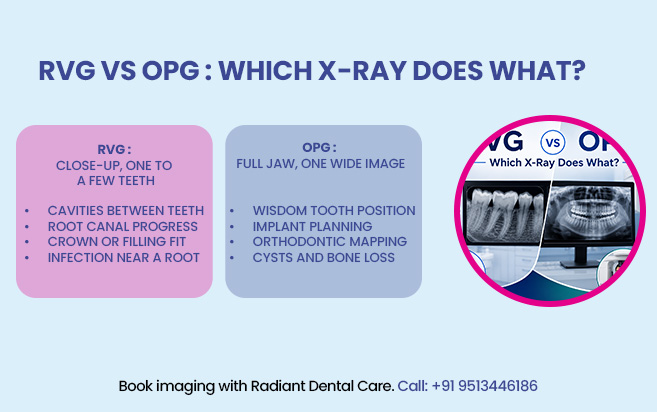
The core difference between RVG and OPG X-rays comes down to scope. RVG shows a few teeth in fine detail. OPG shows the entire mouth in one pass, with less detail on any single tooth.
| Factors | RVG | OPG |
|---|---|---|
| What it shows | One tooth or a few | Entire jaw and both joints |
| Best for | Cavities, root canals, crown fit | Wisdom teeth, implants, orthodontics |
| Machine | Small sensor placed in the mouth | Rotating machine around the head |
Are RVG and OPG X-Rays Safe?
According to the American Dental Association’s 2024 safety recommendations, a routine bitewing X-ray delivers about 5 microsieverts, and a full panoramic X-ray about 20, both far below levels considered risky.
Dentists still follow the ALARA principle, meaning an X-ray only gets taken when there’s a real clinical reason for it, not as a routine formality.
How Does Radiant Dental Care Use RVG & OPG Imaging?
Radiant Dental Care builds both RVG and OPG imaging into standard treatment planning across its Chennai clinics, rather than treating it as an optional extra tacked onto a visit. A root canal treatment is planned with RVG images guiding each stage, while implant and orthodontic cases lean on OPG to map the full jaw before anything is decided.
If you’re comparing options for an affordable dental clinic in Chennai, imaging accuracy is one of the quieter but more important things to check for, since a diagnosis is only as good as the image behind it.
Call +91 9513446186 to book a consultation, and get a diagnosis based on what’s actually happening inside the tooth, not just what’s visible on the surface.
Frequently Asked Questions
Do I need an X-ray for every dental visit?
Not every time, no. A routine cleaning usually doesn’t call for one. Dentists reach for an X-ray when there’s an actual reason to look closer, not as a default step.
Is an OPG X-ray safe for children?
It is, even at a child’s age. The dose is low enough that dentists apply the same rule they use for adults: only order one when there’s a real reason, like checking how permanent teeth are coming in underneath.
How long does an RVG or OPG X-ray take?
Barely any time at all. An RVG is done in seconds. An OPG takes a bit longer, maybe under a minute, while the machine circles around your head to get the full jaw in one shot.
Can an OPG X-ray replace an RVG X-ray?
Not really, and here’s why. OPG covers the whole mouth but loses the fine detail a single tooth needs. Something like a root canal still calls for an RVG’s close-up view.
Does Radiant Dental Care have in-house X-ray facilities?
It does, at every clinic across Chennai. Both RVG and OPG are done on-site, so you walk out with results the same day instead of chasing down an outside lab.
Categories:
- Braces
- Cavity
- Crossbite
- Dental Bridge
- dental care
- Dental Clinic
- Dental Crown
- dental health
- dental hospital
- Dental Implants
- Franchise
- Home dentist
- invisalign
- Mamelons
- News
- pediatric dentist
- Root Canal Treatment
- Smile Makeover
- Teeth Aligners
- teeth alignment
- teeth cleaning
- teeth whitening treatment
- tooth extraction
- Tooth Hypersensitivity
- Uncategorized
Trending Posts
 +91 9513446186