5 Myths About Invisalign You Should Stop Believing

FACT CHECKED
You want straighter teeth, and clear aligners look like the easy route. Then a friend says they hurt, cost a fortune or only fix small gaps. Now you’re not sure it’s worth booking a consultation. Here are the 5 myths about Invisalign you should stop believing.
Invisalign is a branded clear aligner system that moves teeth with a series of custom, removable plastic trays. It treats many crowding, spacing and bite problems. It needs 20 to 22 hours of daily wear, causes brief pressure with each new tray, and costs whatever your case needs.
At Radiant Dental Care, we run 10 dental clinics in Chennai and have successfully treated 1,200+ orthodontic cases. Below, as explained by our expert orthodontists and certified Invisalign providers, you’ll find what’s the actual truth behind each myth and the questions to ask before you pay for Invisalign treatment.
Myth 1: Does Invisalign Only Work for Minor Crooked Teeth?
No. Invisalign treats crowding, gaps and several bite problems. Some complex bites still need braces or a combined plan. An orthodontic assessment tells you which group you’re in.
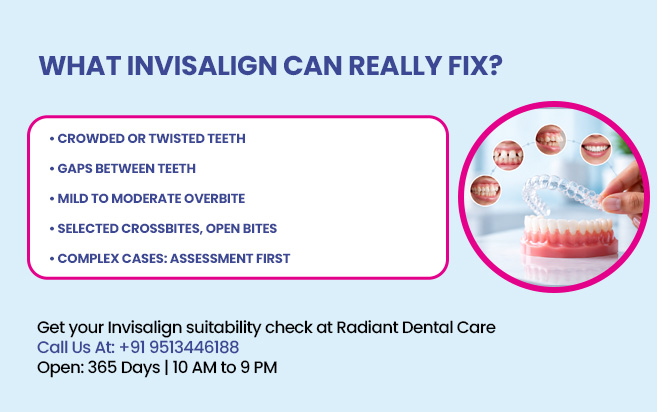
Which Teeth and Bite Problems Can Invisalign Treat?
Malocclusion is the clinical term for teeth or jaws that don’t meet correctly. Once an orthodontist confirms suitability, Invisalign can treat:
- Crowded teeth that overlap or twist
- Gaps between teeth
- Mild to moderate overbite or underbite
- Crossbite, where some upper teeth sit inside the lower teeth
- Open bite, where the front teeth don’t meet when you bite
Many cases also need attachments. These are small, tooth coloured bumps that help the trays grip your teeth. We polish them off when treatment ends.
When Do Braces Work Better?
Plastic trays find some tooth movements harder to control. A 2019 meta-analysis in BMC Oral Health found both aligners and braces corrected malocclusion. But braces did better at making the bite meet evenly and at controlling root position.
A 2024 systematic review in the Journal of Orthodontic Science called aligners a possible effective alternative to braces. It also said more research is needed.
So severe rotations, large jaw differences or cases that need extractions may suit ceramic or metal braces better. Some patients start with braces and finish with aligners.
Some Invisalign cases also need one or two teeth removed to make space. Our orthodontists tell you this at the planning stage, so nothing surprises you later. And remember, Invisalign is one brand among several clear aligners.
Myth 2: Is Invisalign Painless, or Just as Painful as Braces?
Neither. Most people feel pressure for two or three days with each new tray. The American Association of Orthodontists (AAO) describes an adjustment period of about a week at the start. Mild discomfort is common in the first few days.
That pressure means the tray is working. Each tray sits slightly ahead of your current tooth position and pushes teeth toward the next step. Most people describe a dull ache when they bite.
These habits help in the first few days:
- Switch to a new tray at bedtime and sleep through the tightest hours
- Eat soft food like idli, pongal or curd rice for a day or two
- Check with us before you take any painkiller
Sharp pain, pain that gets worse after a few days, or a tray edge cutting your gum isn’t normal. Call us.
Myth 3: Can You Take Your Aligners Out Whenever You Like?
You can take them out, but they only move teeth while you wear them. The AAO advises at least 22 hours a day. That leaves you about two hours for meals and cleaning.
Your daily routine will look like this:
- Remove the aligners before every meal or snack.
- Drink only plain water while they’re in.
- Brush, or at least rinse, before you put them back.
- Store them in their case, never in a tissue.
- Clean the trays every morning and night.
If you eat out often, carry a small kit with a travel brush, paste and the case. It’ll save you from skipping a brush or leaving the trays out too long.
Chennai habits make this harder. Filter coffee and tea stain the trays and trap sugar on your teeth. Turmeric in curries stains them fast too. And every snack break eats into your 22 hours.
If you skip wear time, the trays stop fitting. We may then need to order refinement aligners, which are extra trays that bring lagging teeth back on plan. That adds months to treatment.
Myth 4: Is Invisalign Treatment Cost in Chennai Out of Reach for Most People?
Not always. Invisalign treatment cost in Chennai depends on how far your teeth need to move. It’s usually higher than metal braces, but a mild case costs far less than a complex one. Only a written quote after a scan gives you a real number, so we share one for your Invisalign treatment before anything starts. A very low quote can leave out refinements or retainers, which you then pay for later.
| Cost factor | How it affects your fee |
|---|---|
| Case complexity | More movement needs more trays |
| Refinements | Extra trays if teeth lag behind |
| Treatment before aligners | Fillings, cleaning or extractions add cost |
| Retainers | Some clinics include them, others don’t |
| Review visits | Months of check-ins add up |
Ask these questions before you accept any Invisalign quote:
- Does the fee include refinement aligners, and how many?
- Does it include retainers?
- How many review visits does it cover?
- Can you pay in EMIs, and on what terms?
Myth 5: Do Your Teeth Stay Straight Forever Once Treatment Ends?
No. Teeth drift back toward their old positions after any orthodontic treatment. A retainer stops this. It’s a custom appliance that holds your teeth in place while the bone and gums around them settle.
The same 2019 BMC Oral Health review found aligners held results less well than braces. So your retainer matters even more after Invisalign.
You’ll get one of two types:
- Removable retainer: a clear tray you can take out
- Fixed retainer: a thin wire bonded behind your front teeth
Many orthodontists ask you to wear a removable retainer most of the day at first, then only at night. Stop wearing it too early, and your teeth can shift enough to undo months of work.
How Do You Choose the Right Invisalign Provider in Chennai?
Choose a dental clinic where an orthodontist plans your case and checks your progress in person. An orthodontist is a dentist with specialist postgraduate training in tooth and jaw alignment.
If you’re searching for the best Invisalign provider in Chennai, check these points first:
- Does an orthodontist assess and plan your case?
- Do you see your planned result on screen before you start?
- Do you get the plan and fee in writing?
- Is there a retainer plan for after treatment?
- Can you reach the clinic easily for reviews?
Our orthodontists at Radiant Dental Care plan aligner cases with intraoral scanners. These handheld cameras build a 3D model of your teeth without messy impression trays. You can pick one of our branches, or the dental clinic near me in Adyar, Chromepet or along OMR, so regular reviews fit your week.
What Happens at Your First Invisalign Consultation?
Your first visit tells you whether Invisalign suits your teeth. Here’s what to expect:
- Our orthodontist checks your teeth, gums and bite.
- A digital scanner maps both jaws.
- You may need an OPG, a single X-ray of both jaws.
- You hear whether Invisalign, braces or a combined plan suits you.
- You get a written plan with a timeline and cost.
If you have cavities or gum problems, we treat those first.
So, What Should You Believe About Invisalign?
The 5 myths about Invisalign you should overcome today all oversimplify. Your result depends on your bite, your wear habits and your retainer. A proper assessment tells you what’s realistic before you spend anything.
Ready to Check Whether Invisalign Is Right for You?
Book an Invisalign suitability consultation at the Radiant Dental Care clinic nearest you. You’ll leave with a scan, a clear answer and a cost you can plan around.
Call us now at +91 9513446188 to book your Invisalign consultation at any of our 10 dental clinics.
Frequently Asked Questions
Can you sleep with Invisalign aligners in?
Yes. You wear them through the night, and those hours count toward your daily total. Brush before bed so food doesn’t get trapped under the trays.
Does Invisalign affect your speech?
Some people notice a slight lisp in the first few days. It usually fades as your tongue gets used to the trays.
Will people notice you’re wearing Invisalign?
Most people won’t notice at normal speaking distance. Attachments show slightly up close, and stained trays stand out, so clean them daily.
How long does Invisalign take to straighten teeth?
Mild corrections can take a few months. Complex cases can take a year or longer. We give you an estimate after your scan.
Does Invisalign work for children?
Yes, in selected cases. Invisalign First suits children aged 6 to 10 with growing teeth and jaws, and teens can use standard Invisalign. Our orthodontist checks whether your child is suitable.
Categories:
- Braces
- Cavity
- Crossbite
- Dental Bridge
- dental care
- Dental Clinic
- Dental Crown
- dental health
- dental hospital
- Dental Implants
- Franchise
- Home dentist
- invisalign
- Mamelons
- News
- pediatric dentist
- Root Canal Treatment
- Smile Makeover
- Teeth Aligners
- teeth alignment
- teeth cleaning
- teeth whitening treatment
- tooth extraction
- Tooth Hypersensitivity
- Uncategorized
Trending Posts
 +91 9513446186