Teeth Cleaning in Chennai: What It Does, What to Expect, and When to Book?

FACT CHECKED
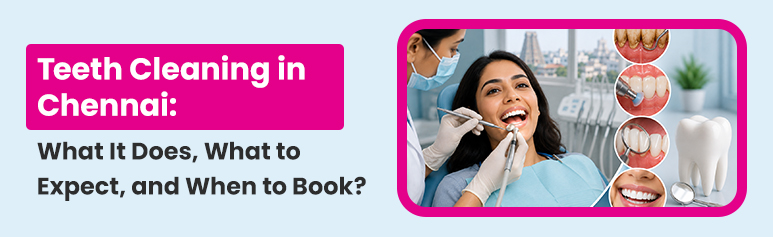
That brown line along your gum, the one you keep noticing when you smile in photos, that is tartar. Brushing will not shift it. It has been building since the last time you had a professional dental cleaning.
Teeth cleaning in Chennai is also called dental prophylaxis or oral prophylaxis. It is the single most effective way to prevent gum disease, tooth decay, and halitosis before they need treatment. Once plaque hardens into tartar, which is also called calculus, no toothbrush, mouthwash, or home remedy removes it. Only a dental scaler does.
At Radiant Dental Care, we carry out scaling and polishing across all 10 Chennai clinics using calibrated ultrasonic instruments and Class B autoclave-sterilised tools. Dr Sreenayana Sinha Roy, MDS, Clinical Director, oversees preventive dental care across the network.
What Does Professional Teeth Cleaning Actually Remove?
Brushing cleans the visible tooth surface. The deposits that build up between teeth, along the gum line, and below it need a different instrument entirely.
Professional dental cleaning in Chennai removes four things that brushing and flossing cannot fully address:
- Plaque (biofilm): the soft bacterial film that forms continuously on teeth. Brushing removes it from surfaces you reach. Most people consistently miss the spaces between teeth and the area just below the gum line where gingivitis starts.
- Tartar (calculus): plaque that has hardened into a rough deposit bonded to the tooth surface. Once tartar forms, brushing has no effect. Only a scaler removes it. Tartar above the gum line is supragingival calculus. Below the gum line, it is subgingival calculus.
- Subgingival deposits: tartar in the pocket between tooth and gum. This is where bacteria cause periodontal disease and, over time, gum recession and bone loss.
- Surface stains: from tea, filter coffee, tobacco, and certain foods. The polishing step removes these during the same appointment.
Tartar sits against your enamel around the clock. It feeds bacteria that produce acid, which causes enamel demineralisation and decay. Those same bacteria trigger the gum inflammation that becomes gingivitis, and then periodontal disease if left untreated. Brushing does not get to it. Professional cleaning does.
What Happens at a Teeth Cleaning Appointment in Chennai?
Most patients who come in nervous about scaling leave surprised by how straightforward it was. Here is every step.
- Examination First: before using any instrument, I check your gums for pocket depths, look for bleeding on probing, and assess how much tartar has built up. Bleeding on probing means gum inflammation is active. This tells me what your mouth actually needs that day.
- Ultrasonic Scaling: a small vibrating tip breaks up tartar above and below the gum line using ultrasonic energy and water. You hear a steady hum. There is no cutting. The vibration breaks the calculus off the surface.
- Hand Scaling: small manual instruments clear any remaining deposits in tight spaces between teeth where the ultrasonic scaler cannot reach fully. Nothing gets missed.
- Polishing: a rotating rubber cup with a mildly gritty paste removes surface stains and leaves the tooth smooth. A smooth surface makes it harder for new plaque to grip quickly after the appointment.
- Floss and Rinse: we floss between your teeth to clear debris loosened during scaling, then rinse. I check the gum line to confirm the cleaning is complete.
- Dental Hygiene Review: I tell you what I found, which areas need more attention at home, and how soon to come back based on your tartar level and periodontal health.
A routine appointment takes 30 to 45 minutes. If there is significant subgingival tartar or active gum disease, you need scaling and root planing, which is a deeper cleaning session. That runs 45 to 90 minutes or splits across two visits, upper and lower separately.
Does Teeth Cleaning Hurt and Is It Safe?
For most patients, scaling feels like mild pressure and vibration. Not pain. The ultrasonic scaler uses water and vibration. It does not cut or drill.
Where it gets uncomfortable is when gums are already inflamed from tartar buildup. I see this regularly in patients who haven’t had a clean in two or three years. Inflamed gums are more reactive to pressure. The cleaning is exactly what reduces that inflammation. Once the tartar is gone, the gum heals. The next appointment is much easier.
For patients with heavy subgingival buildup, we use local anaesthesia so the appointment stays comfortable throughout.
Does Scaling Damage Enamel or Loosen Teeth?
No, and this comes up constantly. Scaling removes deposits that sit on the outer surface of the tooth. It does not touch the enamel underneath. Published dental evidence is consistent on this. The myth comes from how teeth feel different after a deep clean, which I explain below.
Tartar sits against the enamel feeding acid-producing bacteria directly onto it. Removing that tartar stops the acid exposure. It protects enamel, not threatens it.
On the loosening question: some patients feel their teeth are slightly more mobile right after a deep clean. Tartar was filling the spaces between teeth artificially. When it is removed, the teeth settle back to their natural position. That sensation passes within a few days. It is not the tooth loosening in the bone.
How Often Do You Need Teeth Cleaning in Chennai?
Every six months is the standard recommendation. I adjust that based on what I see. Some mouths accumulate calculus faster. Some patients have conditions where longer gaps create a real clinical risk to their periodontal health.
| Patient Type | Recommended Frequency |
| Healthy adults with good dental hygiene at home | Every 6 months |
| Patients with gingivitis or active gum disease | Every 3 to 4 months |
| Diabetic patients | Every 3 to 4 months |
| Smokers | Every 3 to 4 months |
| Patients wearing braces or aligners | Every 3 to 4 months |
| Patients who accumulate tartar quickly | Every 4 months |
I have a patient at our Adyar clinic who used to come in once a year. She always had heavy calculus on her lower front teeth and along the upper gum line. We moved her to every four months. Her gum bleeding stopped. Tartar levels dropped at each visit. Her pocket depths went from 4 mm to 2 mm over two years of consistent cleaning. That is what a regular schedule does.
If you have been told you have gum disease and are unsure what cleaning schedule that requires, the gum treatment page explains how cleaning frequency connects to gum disease management and recovery.
What to Do After Your Teeth Cleaning Appointment?
The 24 to 48 hours after a clean matter. Your gum tissue is settling and the tooth surface is freshly polished. A few steps help the results last longer.
- Avoid very hot, cold, or acidic food and drinks for the first 24 hours if you feel sensitivity. The exposed surfaces are more reactive until the gum settles.
- Brush gently on the first day with a soft-bristled brush. Give the gum tissue one day before applying normal pressure.
- Floss from the next day. If your gums bleed slightly, that is existing inflammation resolving. It stops within a day or two.
- Skip tea, filter coffee, and tobacco for the first 48 hours. These stain the surface before the polish has settled fully.
- If sensitivity does not improve after 48 hours, come back in. Worth checking rather than waiting.
If you’ve noticed halitosis alongside the tartar buildup, the bad breath causes and treatment guide explains why tartar and bad breath are directly connected, and whether dry mouth, gum disease, or another factor is also contributing.
Book Your Teeth Cleaning at Radiant Dental Care
A six-monthly cleaning costs significantly less than a filling, and far less than scaling and root planing for active gum disease or gum surgery. Most of those treatments become necessary when calculus is left too long. The cleaning is what stops that progression.
Radiant Dental Care is the best dental clinic in Chennai for professional teeth cleaning and periodontal health monitoring. Every appointment includes:
- Scaling and polishing with calibrated ultrasonic instruments
- Gum pocket assessment and bleeding on probing check at every visit
- Dental hygiene guidance based on what I find at your specific appointment
- Written treatment plan and cost estimate if any follow-up is identified
- Class B autoclave-sterilised instruments at every Radiant Dental Care location
For a full cost breakdown before booking, the teeth scaling cost in Chennai guide covers all procedure types and what drives the price difference between clinics.
Patients searching for a dental clinic in Chennai for teeth cleaning or dental cleaning Chennai-wide will find Radiant Dental Care in Adyar, Tambaram East, Chromepet, Nanganallur, Medavakkam, Navalur OMR, Siruseri OMR, Perungudi OMR, Guduvanchery, and Thiruporur. Open 365 days, 10 AM to 9 PM.
Call us at +91 9513446186 and book your teeth cleaning appointment at Radiant Dental Care
Frequently Asked Questions
Is Professional Teeth Cleaning the Same as Teeth Whitening?
They are two different procedures. Oral prophylaxis removes tartar, plaque, and surface stains. Whitening chemically lightens the shade of the tooth. One is preventive dental care. The other is cosmetic.
Can I Eat Before a Teeth Cleaning Appointment?
Yes, eat normally. No fasting needed. If sedation or a more involved procedure is planned alongside the cleaning, your dentist will advise on any restriction beforehand.
How Long Does Teeth Cleaning Take in Chennai?
A routine scaling and polishing takes 30 to 45 minutes. Scaling and root planing for active gum disease takes 45 to 90 minutes, sometimes split across two appointments for upper and lower arches.
Will My Gums Bleed During Teeth Cleaning?
They may, if there is existing gingivitis or inflammation from tartar buildup. Bleeding during scaling is inflamed tissue responding to the removal of what was irritating it. It settles as the gums heal over the following days.
Does Teeth Cleaning Remove All Stains Permanently?
Surface stains from tea, coffee, and tobacco are removed during polishing. Intrinsic discolouration from inside the tooth is not affected by scaling or polishing. Those require a separate whitening procedure.
How Do I Know If I Need Scaling and Root Planing or Just a Routine Clean?
Your dentist measures gum pocket depths at each visit. Pockets deeper than 3 mm with subgingival calculus and bleeding on probing indicate scaling and root planing is needed. A routine examination confirms which applies.
Categories:
- Braces
- Cavity
- Crossbite
- Dental Bridge
- dental care
- Dental Clinic
- Dental Crown
- dental health
- dental hospital
- Dental Implants
- Franchise
- Home dentist
- invisalign
- Mamelons
- News
- pediatric dentist
- Root Canal Treatment
- Smile Makeover
- Teeth Aligners
- teeth alignment
- teeth cleaning
- teeth whitening treatment
- tooth extraction
- Tooth Hypersensitivity
- Uncategorized
Trending Posts
 +91 9513446186