Dental Crown Types and Cost in India – A Comprehensive Guide

FACT CHECKED
Your dentist has told you that you need a crown. Now you’re staring at options you’ve never heard of: zirconia, PFM, E.max. And a cost range that spans thousands of rupees. That’s a frustrating place to be.
Here’s the direct answer: dental crown cost in chennai typically ranges from ₹2,500 to ₹30,000 per tooth. The right type depends on which tooth needs it, how much bite pressure it takes, and how visible it is when you smile. There’s no single best crown for everyone.
At Radiant Dental Care, a multi-specialty dental network across Chennai, crown planning uses digital scans and CAD/CAM technology to match each patient’s specific tooth condition and functional need. This guide covers every crown type, what it actually costs, and how to decide. You’ll walk into your consultation already knowing what to ask.
What Is a Dental Crown and When Do You Need One?
A dental crown is a tooth-shaped cap that fits over a damaged or treated tooth to restore its shape, strength, and appearance. It covers the entire visible part of the tooth above the gum line.
Read to understand more about the roles and benefits of dental crowns for stronger teeth.
You’ll likely need a crown in these situations:
- Your tooth has a large cavity that a filling can’t support
- Your tooth is cracked or severely worn down
- You’ve had a root canal treatment on a back tooth
- You need to anchor a dental bridge, a fixed replacement for one or more missing teeth supported by adjacent teeth
- A dental implant needs a visible tooth on top
- Your tooth is discoloured or misshaped and you want a lasting cosmetic fix
Not every damaged tooth needs a crown immediately. A dentist will assess the remaining tooth structure, its location in your mouth, and your bite before recommending one. A front tooth with minor chipping, for example, may do fine with a composite restoration instead.
What Are the Different Types of Dental Crowns in India?
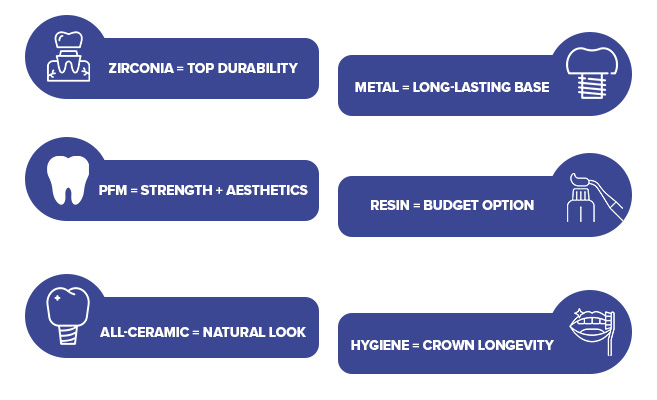
There are five main crown materials used in India. Each one suits different teeth, budgets, and clinical needs.
Zirconia Crown
Zirconia is a strong, tooth-coloured ceramic material. It’s metal-free, looks natural, and handles high bite pressure well. That makes it suitable for both front and back teeth.
It’s milled using CAD/CAM technology, which means a digital scan of your tooth produces a crown shaped for precise fit. Most patients can’t tell a zirconia crown apart from their natural teeth.
- Approximate cost: ₹12,000 to ₹25,000 per crown
- Best for: Back molars where strength matters, front teeth where appearance is the priority, patients with metal sensitivities.
E.max Crown
E.max is a lithium disilicate ceramic, a glass-ceramic material. It’s known for its high translucency. It mimics the way natural tooth enamel reflects light, which gives it an exceptionally realistic look.
It’s the go-to material for front teeth restorations where appearance is critical. It’s strong enough for many cases, but isn’t always recommended for heavy-bite posterior teeth.
- Approximate cost: ₹12,000 to ₹25,000 per crown
- Best for: Front teeth, cosmetic restorations, patients who want the most natural-looking result.
Porcelain-Fused-to-Metal (PFM) Crown
A PFM crown has a metal base for structural strength with a porcelain outer layer that matches your tooth colour. It’s been the standard restorative crown for decades.
The limitation is that over time, the metal base can show as a thin dark line near the gum, particularly as gums naturally recede with age. Some patients also prefer to avoid metal entirely.
- Approximate cost: ₹5,000 to ₹15,000 per crown
- Best for: Back teeth where aesthetics aren’t the primary concern, patients looking for a mid-range cost option.
Full Metal Crown
A full metal crown uses gold alloy, nickel, or chromium. It’s extremely durable and requires less tooth removal than most other types. The trade-off is that it’s visually obvious.
Gold crowns are very rarely chosen today for visible teeth, but they remain a strong, long-lasting option for back molars where no one sees them.
- Approximate cost: ₹3,000 to ₹8,000 per crown (varies with gold rates)
- Best for: Back molars, patients where longevity is the top priority and aesthetics don’t matter.
Composite Resin Crown
A composite resin crown uses a tooth-coloured plastic material. It’s the most affordable option, but it wears down faster than ceramic or metal and stains more easily.
These are often used as temporary crowns while a permanent one is being made, or for low-load situations. They’re not a long-term solution for most cases.
- Approximate cost: ₹2,500 to ₹5,000 per crown
- Best for: Temporary use, children’s primary teeth, very low-load situations.
| Crown Type | Strength | Aesthetics | Approx. Cost (INR) | Best For |
|---|---|---|---|---|
| Zirconia | Very High | Excellent | ₹12,000 – ₹25,000 | Front and back teeth |
| E.max | High | Outstanding | ₹12,000 – ₹25,000 | Front teeth, cosmetic cases |
| PFM | High | Good | ₹5,000 – ₹15,000 | Back teeth, mid-range budget |
| Full Metal | Very High | Poor | ₹3,000 – ₹8,000 | Back molars only |
| Composite Resin | Low | Fair | ₹2,500 – ₹5,000 | Temporary use |
How Much Does a Dental Crown Cost in India?
Tooth crown cost in India ranges from ₹2,500 to ₹30,000 depending on material, technology, and clinical complexity. That’s a wide range, and it’s wide for legitimate reasons.
What Affects Dental Crown Cost in Chennai?
Dental cap cost in Chennai varies based on several factors that most patients don’t think to ask about:
- Material chosen: Zirconia and E.max cost more than PFM or metal. The higher price reflects better materials, longer lifespan, and more precise fabrication.
- CAD/CAM technology: Clinics that use digital scans and computer-milled crowns typically invest more in fabrication. That precision often means a better fit and less post-placement adjustment.
- Tooth location and condition: A molar with heavy bite load may need a stronger material than a front tooth. If the tooth needs a post-and-core first, a structural base built inside a root-canal-treated tooth to support the crown when insufficient structure remains, that adds to the total cost.
- Temporary crown: Most multi-visit crown procedures include a temporary crown while the permanent one is made in a dental lab. This is rarely quoted upfront.
- X-rays and diagnostic scans: These are needed for treatment planning and aren’t always included in the crown price quote.
- Lab quality: Crowns made in certified digital dental labs have higher accuracy and finish than those from low-cost manual labs. Ask your clinic where the crown is fabricated.
Always ask for a full treatment cost breakdown before you agree to proceed. Don’t settle for just the crown material price.
Front Tooth or Back Tooth: Why Crown Location Changes Everything?
The tooth’s position in your mouth is one of the most important factors in choosing a crown. It’s not just about the crown type, it’s about what that tooth does every day.
- Front teeth (incisors and canines) are visible when you speak and smile. They don’t take as much direct bite pressure as back teeth. The priority here is appearance. Zirconia and E.max crowns work best because they closely match the look of natural enamel.
- Back teeth (premolars and molars) absorb most of the chewing force in your mouth. They’re rarely visible. The priority is strength and durability. Zirconia crowns work well here too because they combine strength with reasonable aesthetics. PFM and metal crowns also remain appropriate options for molars depending on the case.
Choosing a crown purely on cost without considering tooth location is one of the most common mistakes. An E.max crown on a molar in a patient with a heavy bite, for instance, carries a higher fracture risk than a zirconia or PFM crown would.
Will My Dental Crown Look Like a Real Tooth?
Yes. If the right material is chosen and placed by an experienced dentist, a crown can be virtually indistinguishable from your natural tooth.
This is the question most patients hesitate to ask, but it’s the one that matters most to them. The short answer is that material choice and shade matching make all the difference.
Zirconia and E.max crowns are designed to reflect light the way natural enamel does. They’re shade-matched to your surrounding teeth using digital or visual guides before fabrication. When placed correctly, they don’t look like a foreign object, they look like part of your smile.
PFM crowns look good too, but the metal base can create a slightly opaque appearance at the gum line over time. If you have naturally thin gums or your gums recede with age, that dark line becomes more visible.
Metal crowns won’t look like natural teeth. That’s just the trade-off for their durability.
If looking natural is your priority, discuss E.max or zirconia with your dentist. The cost difference is real, but so is the visual difference.
What Is CAD/CAM Crown Technology and Does It Make a Difference?
CAD/CAM stands for computer-aided design and manufacturing. In crown treatment, it means your tooth is scanned digitally rather than with traditional putty moulds, and the crown is then milled from a solid block of ceramic or zirconia using a computer-controlled machine.
The result is a crown that fits more precisely to your prepared tooth. Less material needs to be removed for adjustments. The fit at the margins, the edge where the crown meets the gum, is typically more accurate.
At Radiant Dental Care, the computerised crown workflow uses intraoral digital scanning for treatment planning. Zirconia and E.max CAD/CAM crowns are part of the restorative options available. The process removes much of the guesswork that comes with manual fabrication.
Does it cost more? Yes, often. Does it make a measurable difference? For patients who want a precise fit, a natural appearance, and minimal post-placement sensitivity, the answer is generally yes.
What Happens During a Dental Crown Procedure?
Most crown procedures take two appointments. Here’s what to expect across both visits:
- Clinical evaluation: The dentist examines the tooth, takes X-rays, and confirms whether a crown is needed. If the tooth has had a root canal or has very little structure remaining, a post-and-core may be placed first.
- Tooth preparation: The tooth is shaped under local anaesthesia to make room for the crown. You won’t feel pain during this step, only pressure.
- Digital scan or impression: Either a digital intraoral scan or a traditional impression captures the shape of your prepared tooth and surrounding teeth.
- Temporary crown: A temporary crown is placed to protect the prepared tooth while your permanent crown is made.
- Crown fabrication: Your permanent crown is made in a dental lab or milled using CAD/CAM technology, usually within one to two weeks.
- Permanent placement: The temporary crown comes off, your permanent crown is checked for fit and bite, then bonded into place.
Some clinics with in-house CAD/CAM milling can complete the process in a single appointment. Confirm this with your clinic before booking.
How many visits does a crown take?
Two visits in most cases. Some clinics with same-day milling capability can complete the process in one visit, though this depends on the case and clinic setup.
How Long Do Dental Crowns Last?
Crown lifespan depends on the material, oral hygiene, and bite habits.
| Crown Type | Typical Lifespan | Key Factor Affecting Longevity |
|---|---|---|
| Zirconia | 15 – 20 years | Bite habits, gum health |
| E.max | 10 – 15 years | Bite load, tooth location |
| PFM | 8 – 12 years | Porcelain chipping risk |
| Full Metal | 15 – 20+ years | Rarely fractures |
| Composite Resin | 3 – 5 years | Wear and staining |
These are typical ranges, not guarantees. Actual lifespan varies by individual case and care.
What makes crowns last longer?
- Brush twice daily with a soft-bristled toothbrush
- Floss around the crown every day to clean the margin
- Avoid biting hard objects like ice, pens, or hard candy
- Wear a night guard if you grind your teeth, since grinding puts significant force on crowns
- Visit your dentist for regular check-ups so any early wear or margin issues get caught
Crown After Root Canal Treatment, Do You Always Need One?
Not always, but it’s commonly recommended for back teeth. Here’s why.
A root canal treatment removes infected pulp tissue from inside the tooth. The tooth remains in place, but it loses the internal blood supply that helped keep it hydrated and flexible. Over time, the tooth can become more brittle.
For front teeth with minimal remaining damage, a well-placed filling may be enough. For back molars that absorb heavy chewing force daily, a crown significantly reduces the risk of the tooth cracking under pressure.
Your dentist will assess the remaining tooth structure after the root canal before recommending a crown. It’s a clinical decision, not a routine requirement for every case. If you’ve recently had a root canal, the dos and don’ts of root canal aftercare can help you understand what to expect in the recovery period before crown placement.
Ready to Find the Right Crown for Your Tooth? Book Your Appointment Now
The right crown depends on your tooth’s location, condition, and what your bite demands. There’s no universal answer, which is why a proper clinical evaluation matters before you decide.
Radiant Dental Care offers computerised crown planning with zirconia and E.max CAD/CAM options across its multi-specialty clinics in Chennai. The warranty coverage for selected treatments reflects a commitment to restorations that last.
Dental cap cost in Chennai varies by material, technology, and case complexity. Always ask for a full cost breakdown before you commit.
Call us at +91 9513446186 and book a crown consultation at your nearest Radiant Dental Care branch in Chennai.
Frequently Asked Questions
What is the cheapest dental crown option available in India?
Composite resin crowns are the most affordable, typically costing between ₹2,500 and ₹5,000. Metal crowns are also budget-friendly at ₹3,000 to ₹8,000. Both are durable for their intended use, but neither offers the aesthetics or lifespan of zirconia or E.max for permanent restorations.
Is a crown always needed after a root canal treatment?
No. The decision depends on which tooth was treated and how much healthy structure remains. Back molars that handle heavy bite pressure usually benefit from a crown to prevent fracture. Front teeth with minimal damage may not need one if a good filling can restore function and strength.
What is the dental cap cost in Chennai for a zirconia crown?
Zirconia crown costs in Chennai generally range from ₹12,000 to ₹25,000 per tooth. The final cost depends on the clinic, the digital fabrication process used, and any additional treatment needed before crown placement such as post-and-core or X-rays.
What’s the difference between a zirconia crown and a PFM crown?
Zirconia is an all-ceramic crown, metal-free and highly aesthetic. PFM has a metal base with a porcelain outer layer, strong but may show a dark line near the gum over time. Zirconia generally suits patients who want better appearance and don’t want any metal in their mouth.
Is getting a dental crown painful?
The procedure itself isn’t painful because local anaesthesia numbs the tooth and surrounding area during preparation. Some patients feel mild sensitivity or soreness for a few days after placement. This usually settles on its own. If discomfort persists beyond a week, contact your dentist.
Can a dental crown fall off? What should you do?
It can, though it’s uncommon when placed correctly. If your crown comes off, don’t try to reattach it yourself. Keep the crown safe and contact your dental clinic as soon as possible. Your dentist will clean the tooth and recement or replace the crown depending on its condition.
How do I know which crown type is right for my tooth?
Your dentist will assess the tooth’s location, how much structure remains, your bite pattern, and your cosmetic preferences. There’s no single answer that works for everyone. A clinical evaluation with X-rays is the only reliable way to determine which material and design suits your specific case.
How long does the crown procedure take from start to finish?
Most crown procedures take two appointments, typically spaced one to two weeks apart. The first visit covers tooth preparation, scanning, and temporary crown placement. The second visit places the permanent crown. Clinics with in-house CAD/CAM milling may complete the process in a single visit.
Categories:
- Braces
- Cavity
- Crossbite
- Dental Bridge
- dental care
- Dental Clinic
- Dental Crown
- dental health
- dental hospital
- Dental Implants
- Franchise
- Home dentist
- invisalign
- Mamelons
- News
- pediatric dentist
- Root Canal Treatment
- Smile Makeover
- Teeth Aligners
- teeth alignment
- teeth cleaning
- teeth whitening treatment
- tooth extraction
- Tooth Hypersensitivity
- Uncategorized
Trending Posts
 +91 9513446186