Malocclusion: Symptoms, Causes and Treatment

FACT CHECKED
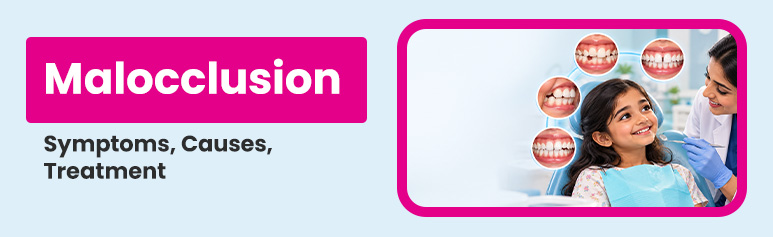
Your dentist used the word malocclusion. Or you’ve noticed your teeth don’t sit right when you bite. Either way, you’re wondering what it means and whether you actually need to do something about it.
Malocclusion is the clinical term for misaligned teeth or a bad bite. Your upper and lower teeth don’t meet correctly when you close your mouth. It’s one of the most common dental findings in India. A study published in the Journal of Orthodontics found that prevalence of malocclusion in Indian populations ranges from 19.6% to 90%, with Class 1 being the most common type. Not every case needs treatment. Whether yours does depends on the type, severity, and how much it affects your daily life.
Dr Soumya V, MDS, our in-house Orthodontist and member of the Indian Orthodontic Society, reviews this guide. She treats malocclusion cases at Radiant Dental Care clinics across Chennai daily. Here’s all about Malocclusion Explained: What It Is and How to Treat It, what type you might have, and exactly what treatment involves.
What Is Malocclusion and How Does It Affect You?
Malocclusion is when your teeth or jaws don’t line up correctly when your mouth closes. Dentists call the way teeth meet “occlusion.” When it works correctly, your back teeth share chewing forces evenly and your front teeth overlap slightly. When it doesn’t, that’s malocclusion.
It isn’t always something that needs fixing. It becomes a clinical concern when it causes difficulty chewing or biting, makes your teeth wear unevenly, or is likely to get worse without treatment. Most people fall somewhere in the mild range and stay there for years without trouble.
What Are the Three Types of Malocclusion and Which One Do You Have?
Dentists classify malocclusion into three types. This system was developed by Edward Angle, an orthodontist, in the late 1800s. It’s still the global standard today. Your class is based on how your upper and lower back teeth sit relative to each other.
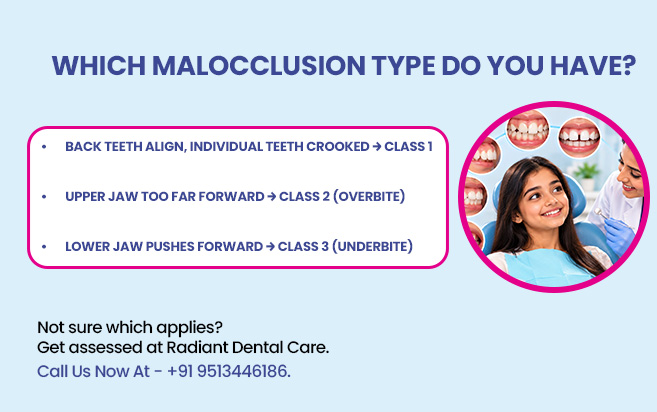
Class 1: Are Your Back Teeth Aligned But Individual Teeth Crooked?
Your back teeth meet correctly. The problem is with individual teeth that are crowded, rotated, spaced, or overlapping. This is the most common type by far. Your bite function works, but tooth positioning makes cleaning harder and in some cases affects appearance.
Class 2: Do Your Upper Teeth Sit Too Far Forward?
Your upper jaw sits significantly further forward than the lower. This is also called an overbite. It has two subtypes. In Division 1, upper front teeth protrude visibly forward. In Division 2, upper front teeth tilt slightly backward but the upper jaw still pushes forward. Both put uneven pressure on the front teeth and can make biting into food difficult.
Class 3: Does Your Lower Jaw Push Forward?
Your lower jaw protrudes forward so your lower teeth sit in front of the upper teeth when you bite. This is called an underbite. It often comes from the jaw position itself rather than just the teeth. It affects how you chew and in more pronounced cases, how certain sounds form when you speak.
What Symptoms Tell You That You Might Have Malocclusion?
Some symptoms you can see. Others you feel. Neither list by itself confirms treatment is needed, but both give your dentist important information.
| Visible Symptoms | Functional Symptoms |
|---|---|
| Crowded, rotated, or overlapping teeth | Difficulty biting or chewing cleanly |
| Protruding upper or lower teeth | Biting your cheek or tongue repeatedly |
| Gaps between teeth | Jaw pain or facial discomfort |
| Teeth that don’t meet when biting | Speech difficulties or a lisp |
| Worn or chipped tooth edges | Habitual mouth breathing |
| Asymmetric jaw appearance | Headaches from jaw strain |
Spotting a few of these doesn’t automatically mean you need treatment. Your dentist or orthodontist looks at the full clinical picture before recommending anything.
What Actually Causes Malocclusion?
Genetics is the primary cause.
Jaw size and tooth size run in families. When the two don’t match, teeth crowd, space out, or sit at wrong angles. You can do everything right and still inherit a bite issue.
Childhood habits also contribute.
- Prolonged thumb sucking or pacifier use puts pressure on developing teeth and jaw structures.
- Mouth breathing as a habit, rather than because of congestion, changes how the jaw forms over time.
- Tongue thrusting, where the tongue pushes against the teeth during swallowing, gradually shifts them.
Dental causes add to the picture.
- Losing baby teeth too early lets neighbouring teeth drift before adult teeth arrive.
- A filling or crown that sits too high changes how the bite meets over time.
- Missing adult teeth cause surrounding teeth to shift into the gap.
- Jaw injuries from accidents can change tooth or jaw position.
- In rare cases, tumours in the jaw or mouth cause acquired malocclusion.
Environmental factors make a genetic predisposition worse, especially in early childhood when the jaw is still forming.
How Do Dentists Actually Diagnose Malocclusion?
Visual inspection alone doesn’t give the full picture. A proper diagnosis needs clinical examination and imaging together. At a dental hospital in Chennai, a malocclusion assessment typically covers five steps.
- Clinical examination: tooth position, bite relationship, and jaw alignment assessed directly
- Dental X-rays: root positions and bone levels checked beneath the gumline
- OPG scan: an orthopantomogram is a wide-angle X-ray capturing all teeth, roots, and both jaws in one image. It shows how the upper and lower jaws relate clearly.
- Digital intraoral scans: capture the bite in three dimensions, more accurately than traditional impressions
- Clinical photographs: taken before treatment and at regular intervals for comparison
At Radiant Dental Care, Dr Soumya V uses digital scans and clinical examination before making any recommendation. No treatment is suggested before the full diagnostic picture is clear.
Do You Actually Need Treatment for Malocclusion?
This is the question most people come in with, and it deserves a straight answer.
Mild malocclusion that isn’t causing functional problems and isn’t getting worse doesn’t need treatment. Monitoring it every six months is enough. Moderate to severe cases are a different matter. Here’s when treatment is generally recommended:
- The misalignment causes difficulty biting or chewing right now
- Teeth are wearing unevenly because of how they meet
- The case is likely to worsen without intervention
- A child is at the right age for early intervention, and waiting means harder treatment later
Monitoring is appropriate when the misalignment is mild with no functional impact, or when the patient is still growing and treatment timing needs careful assessment first.
The honest truth: earlier treatment is almost always simpler. Waiting doesn’t make mild cases worse in most adults, but it does in growing children.
What Treatment Options Are Available for Malocclusion?
Treatment depends on the type, severity, your age, and whether the problem is in the teeth, the jaw, or both.
| Treatment | Best Suited For | Approximate Duration |
|---|---|---|
| Metal braces | Moderate to complex cases | 18 to 36 months |
| Ceramic braces | Moderate cases, less visible preference | 18 to 36 months |
| Clear aligners | Mild to moderate misalignment | 6 to 24 months |
| Functional appliances | Growing children with jaw discrepancy | 12 to 24 months |
| Retainers | After active treatment | Ongoing |
| Orthognathic surgery | Severe skeletal jaw misalignment in adults | Surgery combined with orthodontics |
Timelines are approximate. Your case complexity, age, and how consistently you wear removable appliances all affect duration. A realistic number for your specific case comes from the consultation, not a table.
One thing many patients ask: “Will I need extractions?” Not always. Some cases need a tooth removed to create space. Others don’t. Your orthodontist assesses this at the start.
- Read about metal and ceramic braces at Radiant Dental Care to understand how fixed treatment works.
- Clear aligners suit many adults and older teens who want a less visible option for mild to moderate cases.
- For children showing early jaw or bite problems, early orthodontic intervention during the growth phase is far simpler than correcting the same problem after growth stops.
What Happens If Malocclusion Goes Untreated?
Mild cases usually stay stable. Moderate to severe cases that go untreated for years cause problems that add up quietly.
- Uneven tooth wear: Teeth grinding against each other at the wrong angle wear down faster on specific surfaces. Over years, this causes sensitivity, chipping, and structural damage.
- Higher decay risk: Crowded teeth are harder to clean. Plaque builds where brushing and flossing can’t reach. Decay follows.
- Gum disease: The same bacteria that cause decay in hard-to-clean areas inflame gum tissue over time. Periodontal disease develops without pain until recession or bone loss becomes visible.
- Jaw pain: A misaligned bite puts uneven stress on the jaw joint. Over years, this causes clicking, discomfort, and in some patients, restricted jaw movement.
- Speech: When the bite interferes with tongue movement, certain sounds don’t form cleanly. This can persist into adulthood if the underlying cause isn’t addressed.
Book Your Malocclusion Assessment at Radiant Dental Care
At Radiant Dental Care, Dr Soumya V, MDS, our in-house Orthodontist and member of the Indian Orthodontic Society, assesses each case using digital scans and clinical examination before making any recommendation. Treatment options for every severity level are available across our Chennai locations.
Whether you’re looking for a dentist in Chennai for a first opinion on your bite, or the best dental hospital in Chennai for complex orthodontic correction, you’ll leave your consultation knowing exactly where your case sits and what it needs.
Book your orthodontic consultation at Radiant Dental Care before you decide anything.
Book your appointment across 10 clinics:Adyar,Chromepet,Guduvanchery,Medavakkam,Nanganallur,Navalur OMR,Perungudi OMR,Siruseri OMR,Tambaram East, andThiruporur. Open 365 days, 10 AM to 9 PM. Call +91 9513446186.
What You Need to Know Before You Decide Anything?
Malocclusion is extremely common in India. Most cases are mild and don’t need treatment. The ones that do are best addressed sooner rather than later, especially in children where the jaw is still forming. A clinical assessment with digital scanning is the only way to know which category your case falls into.
Don’t put it off because you’re unsure. One consultation gives you a clear answer. That’s a better starting point than guessing from a blog.
Frequently Asked Questions
Is Malocclusion Hereditary?
Mostly yes. Jaw size and tooth size run in families, and a mismatch between the two causes most cases. Childhood habits like thumb sucking and mouth breathing can make an existing genetic predisposition worse.
Do I Actually Need Treatment for Malocclusion?
Not always. Mild malocclusion that isn’t causing problems and isn’t getting worse often doesn’t need treatment. Moderate to severe cases that affect chewing or are progressing are worth addressing. A clinical assessment tells you which category you’re in.
Will Orthodontic Treatment Be Painful?
Some soreness in the first few days after getting braces or a new aligner set is normal. It settles within a few days. Ongoing sharp pain isn’t normal and should be reported to your orthodontist.
At What Age Is Malocclusion Easiest to Treat?
During growth, typically ages 7 to 14. The jaw responds to guidance while it’s still forming. Adults can be treated at any age, but severe skeletal cases may need surgical correction that wouldn’t have been necessary if caught earlier.
Is a Dental Hospital in Chennai Different From a Regular Clinic for Malocclusion?
A multi-specialty dental hospital with an in-house MDS-qualified orthodontist offers specialist-level planning. This matters for complex cases involving jaw discrepancies or cases needing coordination with other dental work.
Categories:
- Braces
- Cavity
- Crossbite
- Dental Bridge
- dental care
- Dental Clinic
- Dental Crown
- dental health
- dental hospital
- Dental Implants
- Franchise
- Home dentist
- invisalign
- Mamelons
- News
- pediatric dentist
- Root Canal Treatment
- Smile Makeover
- Teeth Aligners
- teeth alignment
- teeth cleaning
- teeth whitening treatment
- tooth extraction
- Tooth Hypersensitivity
- Uncategorized
Trending Posts
 +91 9513446186