Dental Attrition: Symptoms, Causes, Treatments

FACT CHECKED

You’ve noticed your teeth look shorter than they used to. Or you’re getting sensitivity to hot and cold that wasn’t there before. Maybe your dentist mentioned tooth wear at your last check-up and you want to understand what that actually means.
Dental attrition is the gradual wearing down of tooth surfaces caused by tooth-to-tooth contact during chewing or grinding. It is not the same as erosion from acidic food or abrasion from brushing too hard. It is a specific mechanical wear pattern, and unlike cavities or gum disease, it is silent. By the time most patients notice it, meaningful enamel loss has already occurred.
Enamel does not grow back. That’s the most important thing to understand about attrition. Treatment can stop further damage and restore lost structure, but the worn enamel cannot regenerate on its own. Early assessment is the difference between a night guard and a full mouth reconstruction.
At Radiant Dental Care, one of the best dental clinic in Chennai for restorative and preventive care, attrition is assessed with clinical examination and digital X-rays before any treatment is recommended.
What Is Dental Attrition?
Dental attrition is the loss of tooth structure caused specifically by contact between opposing teeth. It appears on the biting surfaces of front and back teeth, and on the edges of the front teeth in more advanced cases. The enamel, which is the hard outer layer of the tooth, slowly thins. Once the enamel is gone, the softer dentine layer underneath becomes exposed.
Dentine is naturally more yellow than enamel. It is also more sensitive, less resistant to bacteria, and wears faster once exposed. This is why attrition tends to accelerate once it reaches a certain point.
How Is Attrition Different from Erosion and Abrasion?
All three are forms of tooth wear, but they have different causes and require different treatments. Confusing them leads to treating the wrong problem.
| Type of Tooth Wear | Cause | Where It Appears |
|---|---|---|
| Attrition | Tooth-to-tooth contact, grinding, or clenching | Biting and chewing surfaces, front tooth edges |
| Erosion | Acid from diet (citrus, fizzy drinks) or acid reflux | Multiple surfaces, especially smooth inner faces |
| Abrasion | External friction, most commonly from hard brushing | Near the gum line, often on one side only |
Many patients have more than one type simultaneously. A dentist distinguishes between them through pattern recognition and patient history before recommending any treatment.
What Are the Symptoms of Dental Attrition?
Attrition develops slowly, which is why many patients don’t connect the symptoms to tooth wear until a dentist points it out. Here is what to watch for.
- Teeth that look shorter or flatter: The biting surfaces have physically worn down. Front teeth may look more uniform and less sharp at the edges.
- Increased sensitivity to hot, cold, or sweet: Enamel thinning exposes the dentine beneath, which sits much closer to the nerve. The sensitivity is often diffuse rather than sharp and localised.
- A yellowish tint on the teeth: As enamel thins, the naturally more yellow dentine shows through. This kind of discolouration doesn’t respond well to whitening because the enamel isn’t the issue.
- Small cracks or chips on tooth edges: Worn teeth lose structural integrity. Front tooth edges become prone to small fractures under normal biting forces.
- Jaw pain, facial tension, or morning headaches: These are common alongside bruxism, which is the habitual clenching or grinding of teeth that often occurs during sleep.
- Changes in how the bite feels: Worn surfaces alter the way upper and lower teeth meet. Patients often describe it as a bite that doesn’t feel quite right, or as increased sensitivity on specific teeth.
A key point: many of these symptoms appear only after significant wear has already happened. A six-monthly dental check with X-rays is the only reliable way to catch attrition in its earlier stages.
What Causes Dental Attrition?
Attrition is rarely caused by one thing. It usually involves a combination of factors that accelerate natural tooth-to-tooth wear.
Bruxism (Teeth Grinding and Clenching)
Bruxism is the most common driver of accelerated attrition. It is defined as the habitual grinding or clenching of teeth, and in most patients it happens during sleep. Because it’s unconscious, many people grind heavily for years without knowing.
The force generated during sleep grinding can be several times higher than the force used during normal chewing. This concentrated, sustained pressure causes enamel to wear far faster than age alone would. Stress, anxiety, and sleep disorders are all established triggers of bruxism.
Misaligned Teeth (Malocclusion)
Malocclusion means the upper and lower teeth don’t come together evenly when biting. Instead of distributing chewing force across multiple teeth, misalignment concentrates it on specific points of contact. Those specific teeth wear significantly faster than the others, and the pattern of wear is uneven.
Age and Natural Wear
Some degree of attrition is expected with age. Decades of normal chewing accumulate gradual enamel loss. What is not expected is severe or rapid attrition, which almost always involves an accelerating factor such as bruxism or malocclusion. Ageing alone rarely produces the extent of wear seen in clinical attrition cases.
Diet and Lifestyle Factors
A diet heavy in hard, crunchy, or tough foods increases the mechanical load on teeth at every meal. Stress is both a direct and indirect contributor: it triggers bruxism and also leads to habits like jaw clenching during waking hours that most patients are unaware of.
How Is Dental Attrition Treated?
Treatment depends on how far the attrition has progressed. The same intervention that works for mild wear is not appropriate for severe wear, and vice versa. Here’s how treatment is typically staged.
Mild Attrition: Stop the Progression First
When attrition is caught early, the priority is preventing further wear before restoring what has been lost.
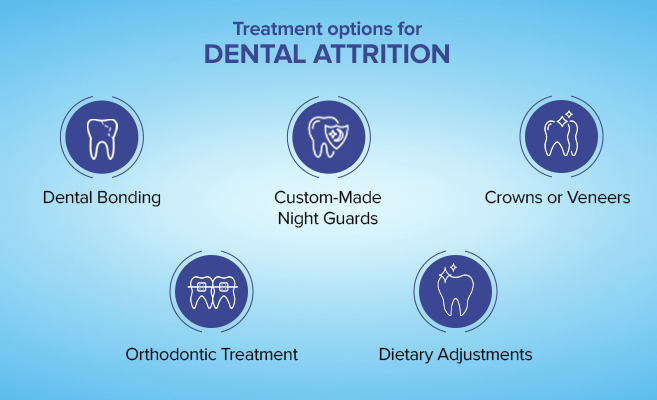
- Custom night guard: A night guard is a custom-fitted appliance worn during sleep that prevents the upper and lower teeth from making direct contact. It does not restore lost enamel, but it stops grinding from causing further damage. This is the most important intervention for bruxism-related attrition.
- Stress and sleep management: Addressing the triggers of bruxism, whether through stress reduction or sleep disorder treatment, reduces the grinding force and frequency over time.
Moderate Attrition: Restore and Protect
When enamel loss has progressed to the point where sensitivity, appearance, or function is affected, restoration becomes necessary alongside protection.
- Dental bonding or composite restorations: Tooth-coloured composite material is used to rebuild worn surfaces. This is appropriate when individual teeth need restoring and the overall bite is manageable.
- Crowns: When a tooth has lost significant structure, a crown restores its full shape, strength, and function. CAD CAM crowns at Radiant Dental Care are designed and milled digitally for precise fit.
- Orthodontic treatment: Where malocclusion is contributing to uneven wear, orthodontic treatment with braces or clear aligners corrects the alignment and redistributes bite force more evenly across all teeth.
Severe Attrition: Full Mouth Rehabilitation
Full mouth rehabilitation is a comprehensive restorative approach for patients where attrition has affected multiple teeth across both arches. It combines crowns, veneers, bite adjustment, and in some cases orthodontics to restore tooth height, function, and appearance across the entire mouth. A night guard is fitted after rehabilitation to prevent the restored surfaces from wearing down again.
What Happens If Dental Attrition Is Left Untreated?
Attrition doesn’t pause on its own. Without intervention, the progression follows a fairly predictable pattern.
- Enamel loss continues, and what has already worn away cannot be recovered
- Exposed dentine increases sensitivity and raises the risk of tooth decay in the worn areas
- Tooth structure weakens progressively, increasing the likelihood of chips and fractures under normal biting force
- Bite changes accumulate, placing uneven stress on the jaw joint and surrounding muscles
- Advanced cases require more extensive treatment, including full mouth rehabilitation, compared to earlier-stage intervention which may only need a night guard and monitoring
For patients who have noticed any of the symptoms above, a professional assessment is the only way to confirm whether attrition is present, how far it has progressed, and what treatment, if any, is needed at this stage. You can also read about the difference between tooth wear and tooth decay to understand which is more likely in your case.
Book Your Dental Attrition Assessment at Radiant Dental Care
If your teeth look shorter, feel more sensitive, or your dentist has mentioned tooth wear at a previous visit, getting a proper assessment is the right next step. Waiting doesn’t slow attrition down.
For patients searching for the best dental clinic in Chennai for attrition assessment and restorative treatment, Radiant Dental Care provides clinical examination, digital X-rays, and a written treatment plan with cost estimate before any procedure is agreed. Here is what is available across all 10 locations:
- Clinical examination and digital X-ray to assess the extent of enamel wear
- Custom night guards for bruxism-related attrition
- Dental bonding and composite restorations for moderate cases
- CAD CAM crowns for teeth with significant structural loss
- Orthodontic treatment where malocclusion is contributing to uneven wear
- Full mouth rehabilitation for advanced, multi-tooth attrition cases
- Professional scaling and polishing as part of preventive care for all attrition patients
For anyone looking for the best dentist in Chennai for restorative dental care, Radiant Dental Care has clinics in Adyar, Tambaram East, Chromepet, Nanganallur, Medavakkam, Navalur OMR, Siruseri OMR, Perungudi OMR, Guduvanchery, and Thiruporur.
Patients searching for the best dental hospital in Chennai or dental care near me can walk in or book online. Open 365 days, 10 AM to 9 PM.
Book Your Dental Attrition Assessment at Radiant Dental Care
Call: +91 9513446186
Frequently Asked Questions
What Is the Difference Between Dental Attrition and Erosion?
Attrition is caused by tooth-to-tooth contact, such as grinding. Erosion is caused by acid from diet or reflux. Both wear enamel but appear in different locations and require different treatment approaches.
Can Dental Attrition Be Reversed?
No. Lost enamel cannot regenerate. Treatment stops further wear and restores lost structure with restorations such as bonding or crowns, but it does not reverse the damage that has already occurred.
Does a Night Guard Fix Dental Attrition?
A night guard prevents further grinding damage during sleep. It does not restore what has already worn away. For patients with existing wear, a night guard is used alongside restorative treatment, not instead of it.
How Do I Know If I Have Bruxism?
Common signs include waking with jaw soreness or headaches, a partner reporting teeth grinding during sleep, and teeth that your dentist notes are flatter or shorter than expected for your age. A dental assessment confirms it.
What Is the Treatment for Severe Dental Attrition?
Severe attrition affecting multiple teeth across both arches is treated with full mouth rehabilitation, which combines crowns, veneers, bite adjustment, and a night guard to restore function and prevent recurrence.
How Often Should I See a Dentist If I Have Attrition?
At minimum every six months, more frequently if active bruxism is present or restorations have been placed. Regular monitoring tracks the rate of wear and confirms whether current protective measures are working.
Categories:
- Braces
- Cavity
- Crossbite
- Dental Bridge
- dental care
- Dental Clinic
- Dental Crown
- dental health
- Dental Implants
- Franchise
- Home dentist
- invisalign
- Mamelons
- News
- pediatric dentist
- Root Canal Treatment
- Smile Makeover
- Teeth Aligners
- teeth alignment
- teeth cleaning
- teeth whitening treatment
- tooth extraction
- Tooth Hypersensitivity
- Uncategorized
Trending Posts
 +91 9513446186