What Are Pterygoid Implants?

FACT CHECKED
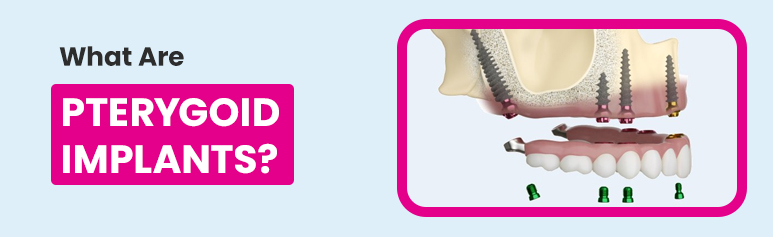
Most people with missing back teeth in the upper jaw hear the same thing at the clinic: “You do not have enough bone for implants.” That is where most consultations end. But it does not have to. What are pterygoid implants is a question more patients are now asking and for good reason. These are special long implants that go into a dense area of bone at the back of the upper jaw where bone loss does not reach. No grafting. No sinus lift. Just a stable fixed solution even when traditional implants are not possible.
At Radiant Dental Care, our implant specialists use guided implant surgery to place pterygoid implants with high precision. We have 9 branches across Chennai and stay open 7 days a week. If you have been told implants are not an option for you, read this first.
What Are Pterygoid Implants and Why Are They Used?
A pterygoid implant is a long dental implant, usually 15 to 20mm, placed in the pterygomaxillary region or at the back of the upper jaw. This area has very dense bone called the pterygoid process of the sphenoid bone. Even when the rest of the upper jaw has lost significant bone, this area stays strong.
Regular implants go straight into the jawbone. When that bone is gone they simply cannot hold. Pterygoid implants bypass that problem entirely by anchoring into this deeper denser bone at an angle of 45 to 55 degrees.
Patients searching for dental implants in Chennai often get turned away due to bone loss. Here is what makes pterygoid implants different from standard ones:
This way best dental clinic in Chennai can go in the conclusion as planned and both keywords sit in their original sections without any reshuffling.
- They are longer: 15 to 20mm vs the standard 10mm.
- They anchor into the cortical bone which is much denser and stronger.
- They do not need bone grafting in most cases.
- They can support fixed teeth much faster than the traditional route.
How Does the Pterygoid Implant Procedure Work?
The surgery requires a highly skilled implant specialist. Here is what happens step by step:
- Your dentist takes a 3D scan of your jaw to plan the exact angle and depth of placement.
- The implant goes in through the back of the upper jaw called the maxillary tuberosity.
- It is placed at a 45 to 55 degree angle to reach the dense pterygoid bone.
- The implant locks into the cortical bone giving immediate stability.
- In many cases fixed teeth are attached on the same day as surgery.
The entire process happens under local anaesthesia. Most patients are surprised by how manageable it is.
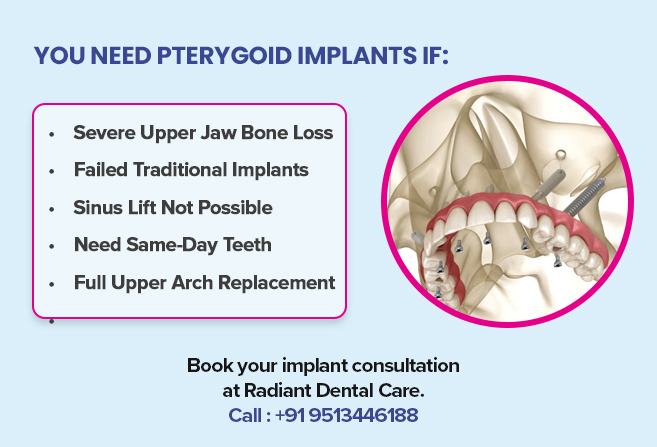
What Are the Benefits of Pterygoid Implants?
For the right patient pterygoid implants offer advantages that no other implant type can match.
- No bone grafting needed in most cases which saves months of waiting.
- No sinus lift required which avoids a complex and costly procedure.
- Teeth can be placed on the same day as surgery in many cases.
- Success rates range from 71% to nearly 100% based on clinical studies.
- Long-term stability due to anchoring in very dense cortical bone.
- A reliable option when all other implant routes have failed.
What Are the Risks of Pterygoid Implants?
Pterygoid implants are safe when placed by an experienced specialist. Like any surgical procedure they carry some risks worth knowing.
- Incorrect placement can affect nearby structures so the surgeon’s skill is critical.
- The angle and depth require advanced 3D planning and guided surgery.
- Not suitable for every patient and a full evaluation is needed before proceeding.
- Rare cases may need follow-up procedures if healing does not go as expected.
The risks stay low when the procedure happens at a clinic with proper technology and trained implant surgeons. This is not a procedure to choose based on price alone.
Missing Back Teeth? Radiant Dental Care Has the Treatment!
Radiant Dental Care offers full implant planning including pterygoid implants across 9 branches in Chennai. Our specialists use 3D guided implant surgery for precise placement every single time. We follow strict sterilisation protocols and offer transparent treatment plans with no hidden costs. We are open 7 days a week so you never have to wait long for a consultation.
Struggling with bone loss and looking for a trusted dentist in Chennai for implants? Call Radiant Dental Care at +91 95134 46188 and find out if pterygoid implants are right for you.
Frequently Asked Questions
Are pterygoid implants painful?
The procedure happens under local anaesthesia so you will not feel pain during surgery. Some soreness after is normal and settles within a few days.
How long do pterygoid implants last?
With proper care they can last many years. Studies show success rates of up to nearly 100% making them one of the most reliable options for patients with severe bone loss.
Can I get teeth on the same day as surgery?
In many cases yes. Because pterygoid implants anchor into very dense bone they offer immediate stability which allows your dentist to attach fixed teeth on the same day.
Do I still need a bone graft with pterygoid implants?
In most cases no. That is the biggest advantage of this implant type. It bypasses the areas with bone loss entirely by anchoring into a denser region of the jaw.
How do I know if pterygoid implants are right for me?
A 3D scan and a consultation with an implant specialist will give you a clear answer. If you have been told traditional implants are not possible this is the next conversation to have.
Categories:
Trending Posts
 +91 9513446186