Delayed Dentition: Understanding Causes and Consequences of Late Teeth Eruption

FACT CHECKED
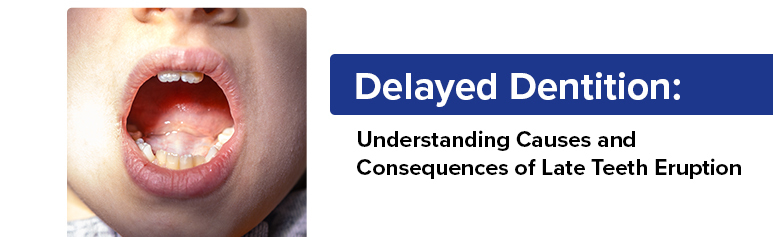
When a tooth erupts later than expected, it can feel stressful, especially when you see other children the same age already have that tooth. Parents usually notice a gap, one side erupting faster than the other, or a baby tooth that is not loosening. This is often called delayed dentition or late eruption.
Here is the clear answer: delayed dentition causes can be linked to growth and health factors, family patterns, or a local blockage in the mouth. Delayed dentition consequences can include bite changes, cleaning difficulty, speech concerns, and confidence issues, which is why timely checks matter.
At Radiant Dental Care, one of the best dental hospital in Chennai with 4.9 stars google rating, we help families clearly understand whether a delayed tooth eruption is within a normal range, needs simple monitoring, or requires early dental planning. If you are unsure about the next step, visit a dentist in Chennai to get clarity and avoid unnecessary worry.
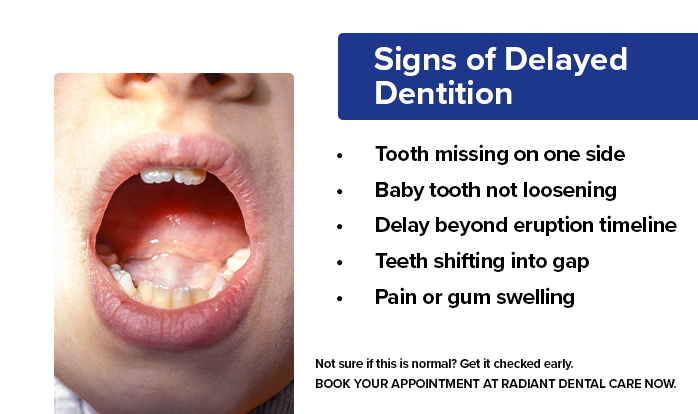
Is Delayed Dentition Normal Or Should You See A Dentist In Chennai?
Delayed dentition can be normal when your child is otherwise healthy and the delay is mild. It needs a dental visit when the delay is long, uneven between sides, or linked to pain, swelling, or space problems.
- Check for asymmetry. If the same tooth is present on one side but missing on the other, it is worth checking.
- Use an eruption chart as a guide, not a deadline. An eruption timeline can vary by child.
- Keep the six month delay idea in mind. If a tooth seems delayed by around six months, it is safer to get an exam.
- Look for a retained baby tooth. This can slow the next tooth’s eruption.
- Notice symptoms. Pain, swelling, or repeated sores should be checked.
What Should Parents Do When A Tooth Is Erupting Late?
Start by tracking which tooth is late, watching for side differences, and keeping oral hygiene strong. The goal is simple, monitor safely and act early if there are warning signs.
Step 1: Note Which Tooth Is Late And For How Long
- Check if the delay involves primary teeth or permanent teeth.
- Compare to an eruption chart to understand what is usually expected.
Step 2: Check For Uneven Eruption And Space Changes
- If there is asymmetry, note which side erupted first.
- Watch for teeth drifting into the empty space, which can cause space loss.
Step 3: Watch For Signs A Tooth May Be Blocked
A tooth can be unerupted, meaning it is still under the gum. In some cases it may be:
- Impacted, meaning it is stuck and not moving up normally
- Ectopic, meaning it is coming in at the wrong angle
- Ankylosed, meaning a baby tooth is fixed in place and does not loosen as expected
Step 4: Keep Oral Hygiene Strong While You Monitor
- Brush gently twice daily.
- Clean between teeth where possible to reduce plaque retention.
- This helps lower caries risk while you wait.
Step 5: Keep A Short Monitoring Note For Two Weeks
- Track weekly change, not daily worry.
- Note any pain, swelling, or chewing difficulty.
- This helps the dentist assess the pattern quickly.
What Are The Most Common Delayed Dentition Causes?
Delayed dentition causes usually fall into three buckets, systemic health factors, genetic patterns, or local mouth factors that block eruption.
Systemic And Medical Causes
These can slow overall growth and affect the eruption timeline:
- Hypothyroidism,
- Vitamin D deficiency,
- Anemia,
- Malnutrition,
- Underweight,
- Prematurity or low birthweight.
Some children may also show growth delay, failure to thrive, or developmental delay, which should be discussed with a doctor.
Genetic And Syndromic Causes
Late eruption can run in families, so genetics and family history matter. Some syndromic or hereditary causes may affect timing, such as Down syndrome. Tooth differences can also affect eruption, such as:
- Hypodontia,
- Supernumerary teeth,
- Microdontia,
- Enamel defects.
Local And Environmental Causes
Local issues are common and can delay eruption even when the child is healthy:
- Trauma or tooth injury, sometimes called TDI,
- Local infection around the root area, including periapical infection,
- Early loss or early extraction of a baby tooth that leads to space loss,
- Crowding,
- Obstruction from thick gingiva, fibrous tissue, retained root, or local pathology.
What Are The Delayed Dentition Consequences If You Wait Too Long?
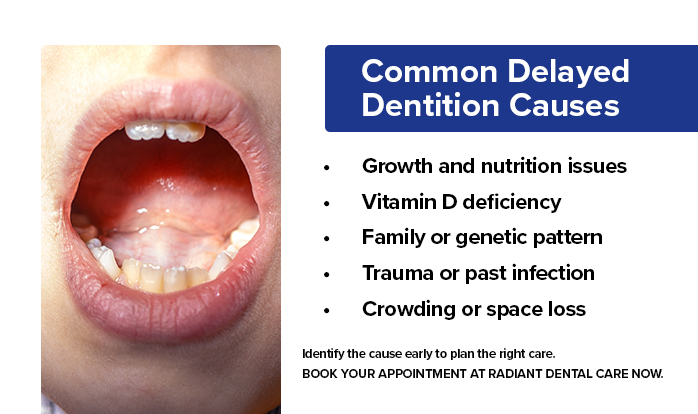
Delayed dentition consequences are mostly about space and bite changes. The longer the delay, the more likely teeth shift, cleaning becomes harder, and habits form.
Bite And Alignment Consequences
Possible effects include:
- Malocclusion,
- Crowding or spacing,
- Open bite or deep bite,
- Crossbite,
- Midline shift.
Oral And Functional Consequences
Some children may develop:
- Chewing difficulty and uneven mastication,
- Poor nutrition if chewing becomes uncomfortable,
- Speech delay, articulation problems, or a lisp,
- Oral habits like tongue thrust,
- Mouth breathing patterns.
Oral Health Consequences
Delayed eruption can increase:
- Plaque retention,
- Caries risk,
- Gum disease,
- Oral hygiene challenges.
Psychosocial Consequences
Gaps or visible delay may affect:
- Esthetics concerns,
- Self esteem,
- Peer teasing,
- Parental concern, which is common and valid.
When Should You Visit The Best Dental Hospital In Chennai For Late Eruption?
You should book a dental visit when the delay is persistent, uneven, painful, or affects space. Early intervention prevents bigger bite issues later.
Book a visit if you notice:
- Clear asymmetry that is not improving,
- Pain, swelling, or repeated infection,
- A retained baby tooth that does not loosen over time,
- Delayed eruption of multiple teeth,
- Teeth drifting and closing space.
How Will A Dentist Diagnose Delayed Dentition And Plan Treatment?
A dentist will confirm whether the delay is harmless or caused by blockage, missing teeth, or space problems. The plan is usually simple and step-by-step.
A dental visit may include:
- growth assessment questions and medical history,
- mouth exam to check space, gums, and the bite,
- panoramic xray if needed to see tooth position under the gum,
- diagnosis and a clear monitoring schedule.
If early support is needed, options may include:
- early intervention to guide eruption and reduce future problems,
- a space maintainer when space is closing,
- interceptive orthodontics when bite guidance is needed,
- treatment planning and regular checkups.
Sometimes a multidisciplinary approach is suggested if medical and dental factors overlap.
How Does Radiant Dental Care Support Children With Delayed Dentition?
Radiant Dental Care helps families understand delayed dentition causes, reduce delayed dentition consequences, and plan the next step with calm, prevention-first care.
Our dentist in Chennai will:
- check eruption pattern and space,
- look for early bite changes and cleaning risks,
- guide monitoring and follow-ups,
- suggest early planning only when needed.
You can visit us at Tambaram East, Adyar, Chromepet, Nanganallur, Medavakkam, Guduvanchery, Navalur OMR, Siruseri OMR, and Perungudi OMR. Drop us a message on WhatsApp at +91 9176166789 to book your appointment.
Conclusion: What Is The Safest Next Step If Your Child’s Tooth Is Late?
If your child has a mild delay and no symptoms, monitoring is often enough. If there is asymmetry, pain, swelling, or space closing, it is safer to get a dental check. Early clarity helps prevent avoidable bite and alignment issues.
Schedule your appointment with the best pediatric dentist in Chennai at Radiant Dental Care now.
FAQs
How much delay is normal for tooth eruption?
A small delay can be normal. If the delay feels long or crosses the six month delay mark, a dental check is a safe step.
What does asymmetry in tooth eruption mean?
It means the same tooth erupted on one side but not the other. This often needs evaluation.
Can vitamin D deficiency delay tooth eruption?
Yes. Vitamin D deficiency can affect growth and may delay tooth eruption in some children.
What happens if a baby tooth does not fall out on time?
A retained baby tooth can block the next tooth’s eruption, so monitoring or treatment may be needed.
When should I visit a dentist in Chennai for late eruption?
Visit if there is pain, swelling, asymmetry, or delayed eruption of multiple teeth.
Can delayed dentition cause braces later?
It can contribute to spacing, crowding, or bite changes. Early checks reduce the risk of bigger problems later.
Categories:
Trending Posts
 +91 9513446186